
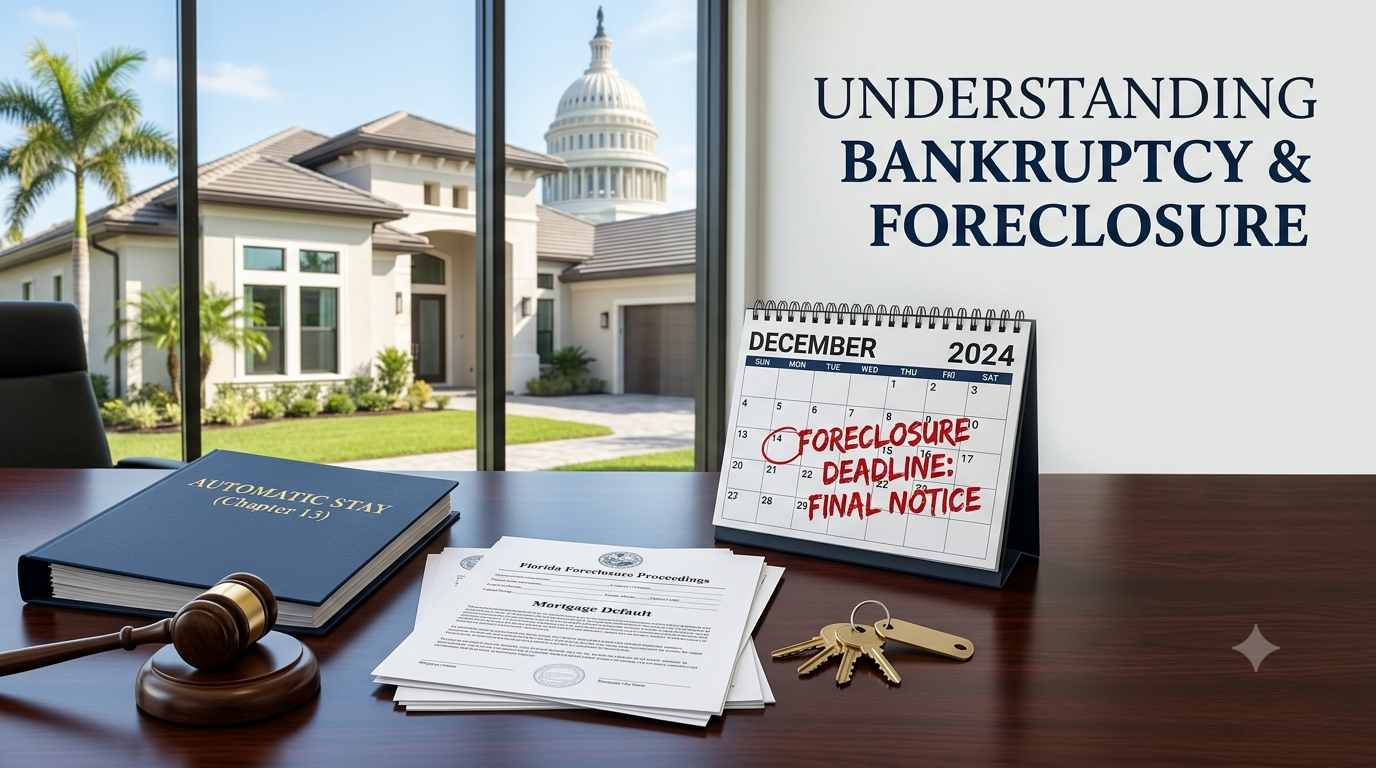
Can Bankruptcy Stop Foreclosure in Florida?
Receiving a foreclosure lawsuit or learning that a foreclosure sale has been scheduled can create immediate pressure for a Florida homeowner. One of the first questions many homeowners ask is: Can bankruptcy stop foreclosure?
Bankruptcy can often pause a foreclosure through a federal legal protection known as the automatic stay. Once an eligible bankruptcy case is properly filed, most creditors must temporarily stop collection activity, including certain foreclosure proceedings.
However, bankruptcy does not automatically erase a mortgage, permanently cancel a foreclosure, or guarantee that a homeowner will keep the property.
The practical result depends on several factors, including the type of bankruptcy filed, the timing of the filing, the homeowner’s income, the amount of the mortgage arrears, the stage of the foreclosure case, and whether future mortgage payments can be maintained.
For homeowners facing foreclosure in Florida, bankruptcy may be one option among several. The underlying foreclosure case should also be reviewed to determine whether defenses, procedural problems, loss-mitigation opportunities, or other resolutions may be available.
What Is Bankruptcy, and Can Bankruptcy Stop Foreclosure?
Bankruptcy is a federal legal process that allows qualifying individuals or businesses to address debt under the supervision of a bankruptcy court.
Depending on the bankruptcy chapter, debts may be discharged, reorganized, or repaid through a court-approved plan.
So, can bankruptcy stop foreclosure?
In many cases, filing bankruptcy before the foreclosure sale can temporarily stop the process through the automatic stay.
The automatic stay generally takes effect as soon as the bankruptcy petition is filed. It usually prevents creditors from beginning or continuing certain collection activities, including:
- Foreclosure proceedings
- Collection lawsuits
- Wage garnishments
- Repossession efforts
- Collection calls and notices
- Enforcement of certain judgments
The automatic stay can provide a homeowner with additional time to evaluate the mortgage default and determine whether a longer-term solution is possible.
However, the protection is usually temporary.
A mortgage lender may ask the bankruptcy court for permission to continue the foreclosure. The automatic stay may also end if the bankruptcy case is dismissed, completed, or otherwise loses legal effect.
Bankruptcy should therefore be viewed as a legal process that may create time and options, not as an automatic or permanent foreclosure solution.
How Bankruptcy Affects the Florida Foreclosure Process
Florida is a judicial foreclosure state. This means a mortgage lender generally must file a lawsuit and obtain a court judgment before the property can be sold through foreclosure.
The foreclosure case proceeds in Florida state court. A bankruptcy case, on the other hand, is handled in federal bankruptcy court.
When a bankruptcy petition is filed, the federal automatic stay can temporarily restrict what the lender is allowed to do in the state foreclosure case.
The Lender Files a Foreclosure Lawsuit
A Florida foreclosure usually begins when the lender files a complaint in the county where the property is located.
The homeowner is served with a summons and complaint and must respond within the applicable deadline.
Ignoring the lawsuit can allow the lender to seek a default. Once a default is entered, the homeowner may have fewer opportunities to dispute the lender’s allegations or raise defenses.
A homeowner should not ignore a foreclosure complaint simply because bankruptcy is being considered. Until a bankruptcy case is actually filed and the automatic stay applies, the state foreclosure case may continue.
The Homeowner Files for Bankruptcy
When an eligible homeowner files a bankruptcy petition, the automatic stay generally becomes effective immediately.
The bankruptcy filing must contain complete and accurate information about the homeowner’s finances, including:
- Income
- Assets
- Debts
- Property ownership
- Bank accounts
- Pending lawsuits
- Recent financial transactions
- Mortgage obligations
- Other creditor claims
Bankruptcy documents are filed under penalty of perjury. Inconsistent or incomplete statements may create significant legal consequences.
Information disclosed in bankruptcy may also affect the foreclosure case. Statements about the property, loan balance, lender, payment history, or mortgage default should be accurate and consistent.
The Foreclosure Is Temporarily Paused
Once the automatic stay applies, the lender generally must stop prohibited foreclosure activity.
Depending on the status of the case, the stay may temporarily pause:
- Pending foreclosure litigation
- Entry of a foreclosure judgment
- Enforcement of an existing judgment
- A scheduled foreclosure sale
- Attempts to obtain possession of the property
- Certain debt-collection communications
The lender, its attorneys, and the state court should receive notice of the bankruptcy filing.
Homeowners should not assume that every party will learn of the filing immediately, especially when the foreclosure sale is scheduled within a short period.
The Lender May Ask to Continue the Foreclosure
A mortgage lender may file a motion asking the bankruptcy court to lift or modify the automatic stay.
This is commonly called a motion for relief from stay.
The lender may argue that:
- The homeowner is not making required payments
- The property has insufficient equity
- The lender’s interest is not adequately protected
- The homeowner cannot fund a realistic repayment plan
- The bankruptcy was filed only to delay foreclosure
- The mortgage default cannot be resolved through the bankruptcy case
If the court grants relief from the stay, the lender may resume the foreclosure even while other parts of the bankruptcy remain pending.
Chapter 7 Bankruptcy and Foreclosure
Chapter 7 is generally designed to discharge qualifying unsecured debts and provide eligible debtors with a financial fresh start.
A Chapter 7 filing can temporarily stop foreclosure through the automatic stay. However, Chapter 7 usually does not provide a long-term method for curing mortgage arrears over several years.
It is important to understand the difference between personal liability and a mortgage lien.
A mortgage transaction usually includes:
- A promissory note that creates personal responsibility for repayment
- A mortgage lien that gives the lender an interest in the property
A Chapter 7 discharge may eliminate the homeowner’s personal responsibility for certain qualifying debts. However, it generally does not remove a valid mortgage lien from the property.
This means the lender may still have the right to foreclose if the mortgage remains unpaid.
Chapter 7 may be useful in situations where a homeowner needs time to:
- Evaluate whether to surrender the property
- Address other overwhelming debts
- Arrange a move
- Consider a negotiated resolution
- Determine whether personal liability may be discharged
- Review the foreclosure case with legal counsel
Chapter 7 may not provide a permanent solution when the homeowner cannot resume regular mortgage payments or cure the default through another method.
Chapter 13 Bankruptcy and Foreclosure
Chapter 13 may provide a more structured option for homeowners who have regular income and want to keep their property.
Under Chapter 13, an eligible debtor proposes a repayment plan that generally lasts between three and five years.
The plan may allow the homeowner to repay past-due mortgage amounts over time while continuing to make required ongoing mortgage payments.
For example, a homeowner may be several months behind on the mortgage but now have enough regular income to make the normal payment. Chapter 13 may potentially allow the homeowner to spread the arrears across the repayment period.
This can make Chapter 13 more useful than Chapter 7 for homeowners whose primary goal is to retain the property.
However, Chapter 13 is not automatically successful.
The homeowner must generally:
- Have sufficient regular income
- Submit an affordable repayment plan
- Make required trustee payments
- Continue ongoing mortgage payments
- Provide accurate financial information
- Attend required hearings
- Complete required courses
- Comply with court deadlines
- Remain eligible for bankruptcy protection
If the homeowner misses plan payments or ongoing mortgage payments, the lender may ask the court for relief from the automatic stay.
If the bankruptcy case is dismissed, the foreclosure may resume.
Can Bankruptcy Stop a Scheduled Foreclosure Sale?
Bankruptcy may stop a scheduled foreclosure sale if the bankruptcy case is properly filed before the sale is completed and the automatic stay applies.
Timing is critical.
A homeowner who waits until the final day may face serious complications, including:
- Incomplete bankruptcy documents
- Failure to complete required credit counseling
- Filing fee problems
- Incorrect information
- Delayed notice to the lender
- Uncertainty about the sale time
- Previous bankruptcy filings
- Limited automatic-stay protection
- Questions about whether the sale was already completed
A rushed filing can result in mistakes, dismissal, or a false belief that the sale has been stopped.
The closer the case is to the foreclosure sale, the fewer options the homeowner may have.
A bankruptcy filing made after the foreclosure sale has been completed may not restore ownership rights in the property.
Homeowners should therefore seek legal guidance well before a scheduled sale whenever possible.
How Long Does Bankruptcy Stop Foreclosure?
There is no single period that applies to every homeowner.
The length of the delay may depend on:
- The bankruptcy chapter
- The homeowner’s prior bankruptcy history
- Whether the lender files for relief from stay
- Whether mortgage payments are being made
- Whether the bankruptcy case remains active
- Whether the repayment plan is confirmed
- Whether the homeowner complies with court requirements
In some cases, the stay may provide only a short delay.
In other cases, Chapter 13 may provide a longer opportunity to cure arrears through a court-approved plan.
The automatic stay is not a guarantee that the foreclosure will remain paused for the entire bankruptcy case.
Common Mistakes Homeowners Make
Bankruptcy can provide important protection, but mistakes can weaken the homeowner’s position or create additional legal problems.
Assuming Bankruptcy Permanently Cancels Foreclosure
The automatic stay generally pauses the foreclosure. It does not automatically cancel the mortgage or permanently eliminate the lender’s rights.
If the default is not resolved, the lender may eventually continue with foreclosure.
Choosing the Wrong Bankruptcy Chapter
Chapter 7 and Chapter 13 serve different purposes.
A homeowner who needs several years to repay mortgage arrears may find that Chapter 7 does not provide the expected structure.
A homeowner considering Chapter 13 may discover that the proposed plan is not affordable.
Waiting Until the Foreclosure Sale Date
Last-minute filings create unnecessary risk.
There may not be enough time to complete required counseling, gather financial records, prepare accurate documents, investigate prior bankruptcy filings, or notify all relevant parties.
Ignoring the Foreclosure Complaint
Considering bankruptcy does not extend the deadline to respond to a foreclosure lawsuit.
Unless the automatic stay is already in place, the lender may continue seeking a default, judgment, or sale.
Providing Incomplete Information
Bankruptcy requires full financial disclosure.
Failing to disclose income, property, accounts, lawsuits, transfers, business interests, or other assets can result in:
- Dismissal
- Loss of discharge
- Trustee action
- Court sanctions
- Other legal consequences
Missing Ongoing Mortgage Payments
A Chapter 13 plan may address past-due payments, but the homeowner may still need to pay the regular mortgage amount going forward.
Missing new payments can allow the lender to seek relief from stay.
Filing Multiple Cases Only to Delay Foreclosure
Repeated bankruptcy filings can limit automatic-stay protection.
Courts may examine whether the filing was made in good faith and whether there is a genuine financial reorganization purpose.
Legal Risks Homeowners Should Consider
Bankruptcy may create valuable protection, but it also affects the homeowner’s broader financial and legal position.
The Mortgage Lien May Survive
A bankruptcy discharge may eliminate personal responsibility for certain debts. It does not necessarily remove the lender’s lien from the property.
The lender may still be able to foreclose if the secured obligation remains unpaid.
The Lender May Obtain Relief From Stay
The lender may ask the bankruptcy court for permission to resume foreclosure.
If the court grants the request, the state foreclosure case may continue even though the bankruptcy remains active.
The Bankruptcy May Be Dismissed
A bankruptcy case may be dismissed if the homeowner fails to:
- File required documents
- Attend required proceedings
- Make plan payments
- Complete required courses
- Provide accurate information
- Follow court orders
When the case is dismissed, the automatic stay generally ends.
Bankruptcy Can Affect Other Financial Matters
Bankruptcy may affect more than the mortgage.
It can influence:
- Credit history
- Business interests
- Jointly owned property
- Pending lawsuits
- Tax obligations
- Future borrowing
- Other secured debts
- Personal guarantees
The entire financial situation should be evaluated before filing.
Foreclosure Deficiency Issues May Remain
If the property sells for less than the amount owed, a lender may seek a deficiency under certain circumstances.
Whether the borrower remains personally responsible may depend on the foreclosure judgment, the bankruptcy discharge, the type of debt, and other case-specific facts.
Alternatives to Bankruptcy
Bankruptcy is not the only option that may be available to a Florida homeowner.
Depending on the facts, alternatives may include:
Loan Modification
A loan modification may change one or more terms of the mortgage, such as the interest rate, monthly payment, loan term, or treatment of arrears.
Approval is not guaranteed, and the homeowner must generally provide detailed financial information.
Repayment Agreement
Some lenders may permit the homeowner to repay missed payments over a shorter period in addition to the regular monthly payment.
Forbearance
A forbearance agreement may temporarily reduce or suspend payments.
The missed amount usually remains due and must be addressed later.
Reinstatement
A homeowner may be able to stop the foreclosure by paying the amount required to bring the mortgage current, including permitted fees and expenses.
Sale of the Property
If the homeowner has sufficient equity, selling the property before the foreclosure sale may allow the mortgage to be paid and may preserve remaining equity.
Short Sale
A lender may agree to accept less than the full amount owed when the property is sold.
The homeowner should understand how any remaining balance will be handled.
Deed in Lieu of Foreclosure
A lender may agree to accept voluntary transfer of the property instead of completing the foreclosure process.
The terms should be carefully reviewed, including whether the lender waives any remaining debt.
Foreclosure Defense
The lender’s lawsuit may contain procedural, evidentiary, servicing, accounting, or standing issues.
A foreclosure defense attorney may review whether the lender has established the legal right to foreclose and whether all required procedures were followed.
Learn more about the firm’s Foreclosure Defense services.
How a Foreclosure Defense Attorney Can Help
A bankruptcy attorney and a foreclosure defense attorney perform different roles.
A bankruptcy attorney evaluates federal bankruptcy options, including:
- Chapter 7 eligibility
- Chapter 13 eligibility
- Debt discharge
- Exemptions
- Repayment plans
- Trustee requirements
- Bankruptcy court filings
A foreclosure defense attorney focuses on the lender’s state-court lawsuit.
A foreclosure review may include:
- The foreclosure complaint
- The promissory note
- The mortgage
- Assignments and endorsements
- Default notices
- Payment records
- Escrow calculations
- Servicing history
- Loss-mitigation communications
- Court deadlines
- Summary judgment motions
- The foreclosure judgment
- The scheduled sale date
A bankruptcy filing may pause the case, but it does not determine whether the lender’s allegations are accurate or whether defenses exist.
Law Offices of Lance Denha, PA can evaluate the Florida foreclosure case and help homeowners understand the legal issues that may affect their options.
Related property matters may also involve the firm’s Real Estate Law services.
Business owners facing foreclosure involving commercial property, personal guarantees, or business obligations may also review the firm’s Business Law services.
Why Timing Matters
Foreclosure and bankruptcy both involve strict deadlines.
Important dates may include:
- The deadline to answer the foreclosure complaint
- Court hearing dates
- Summary judgment deadlines
- Loss-mitigation deadlines
- Bankruptcy counseling requirements
- Bankruptcy filing dates
- The foreclosure judgment date
- The foreclosure sale date
- The redemption deadline
Seeking legal guidance early may allow more time to compare available options.
A homeowner who acts promptly may have time to:
- Review the foreclosure complaint
- Investigate the mortgage records
- Raise appropriate defenses
- Submit a loss-mitigation application
- Negotiate with the lender
- Consider selling the property
- Consult bankruptcy counsel
- Prepare accurate court filings
Waiting until a foreclosure sale is only hours away may significantly limit available choices.
Frequently Asked Questions
Does filing bankruptcy immediately stop foreclosure?
A properly filed bankruptcy case generally triggers an automatic stay that temporarily stops most foreclosure activity.
Exceptions may apply, particularly when the homeowner has filed one or more bankruptcy cases recently.
Can Chapter 7 bankruptcy save my home?
Chapter 7 may temporarily stop foreclosure, but it generally does not provide a long-term repayment plan for mortgage arrears.
The homeowner usually needs another way to cure the default and maintain future payments.
Can Chapter 13 help me catch up on my mortgage?
Potentially.
An eligible homeowner with sufficient income may be able to repay past-due mortgage amounts through a three-to-five-year Chapter 13 plan while continuing ongoing payments.
Can I file bankruptcy after a foreclosure judgment?
A bankruptcy filing may still affect the case if it is filed before the foreclosure sale is completed.
However, available options may become more limited after judgment.
Can I file bankruptcy on the day of the foreclosure sale?
It may be legally possible in some situations, but waiting until the sale date is extremely risky.
Filing errors, notice delays, eligibility issues, or previous bankruptcy cases may prevent the expected protection.
Does bankruptcy remove the mortgage from the property?
Usually not.
Bankruptcy may discharge personal liability for qualifying debt, but a valid mortgage lien may remain attached to the property.
Will the lender automatically lose the foreclosure case?
No.
Bankruptcy generally pauses the foreclosure. It does not automatically defeat the lender’s legal claim.
Can the lender continue foreclosure during Chapter 13?
The lender may ask the bankruptcy court for relief from the automatic stay, particularly if the homeowner misses payments or fails to comply with the repayment plan.
Should I consider bankruptcy or foreclosure defense?
The answer depends on the homeowner’s complete financial and legal situation.
Bankruptcy may address debt and repayment issues. Foreclosure defense focuses on the lender’s lawsuit and whether the lender has established the right to foreclose.
Some homeowners may need advice in both areas.
Why Choose Law Offices of Lance Denha, PA?
Foreclosure cases can involve loan documents, court procedures, property rights, servicing records, settlement negotiations, and strict deadlines.
Law Offices of Lance Denha, PA assists Florida homeowners with foreclosure defense and related real estate matters.
The firm can review the foreclosure lawsuit, determine the current status of the case, examine the lender’s allegations, identify possible legal issues, and explain the options that may be available.
No law firm can guarantee the outcome of a foreclosure case. The purpose of a legal review is to help the homeowner make informed decisions based on the specific facts and deadlines involved.
When bankruptcy may be relevant, the homeowner may also need advice from qualified bankruptcy counsel regarding federal bankruptcy eligibility, repayment plans, exemptions, and discharge issues.
Can Bankruptcy Stop Foreclosure? Final Considerations
Can bankruptcy stop foreclosure?
In many cases, bankruptcy can temporarily stop a Florida foreclosure through the automatic stay. However, it does not automatically erase the mortgage, cancel the lender’s lien, or guarantee that the homeowner will keep the property.
Chapter 7 may provide a temporary pause and address personal liability for certain debts. Chapter 13 may offer eligible homeowners a structured opportunity to repay mortgage arrears over time.
The right option depends on the homeowner’s income, mortgage balance, amount of arrears, foreclosure status, other debts, and long-term financial goals.
The foreclosure lawsuit should also be reviewed independently. Bankruptcy may pause the case, but it does not determine whether the lender has complied with Florida law or whether legal defenses may exist.
Florida homeowners facing a foreclosure complaint, judgment, or scheduled sale may contact Law Offices of Lance Denha, PA at 844-410-4415 to discuss the foreclosure matter and the options that may be available.
Simple answer for can bankruptcy stop foreclosure is yes.
Legal Disclaimer
This article is provided for general informational purposes only and does not constitute legal or bankruptcy advice. Reading this content does not create an attorney-client relationship. Bankruptcy and foreclosure outcomes depend on the specific facts, applicable law, court orders, and filing deadlines. Homeowners should consult qualified legal counsel regarding their individual circumstances.
Law Offices of Lance Denha is licensed in Florida and Michigan. It is led by Attorney Lance Denha.
