
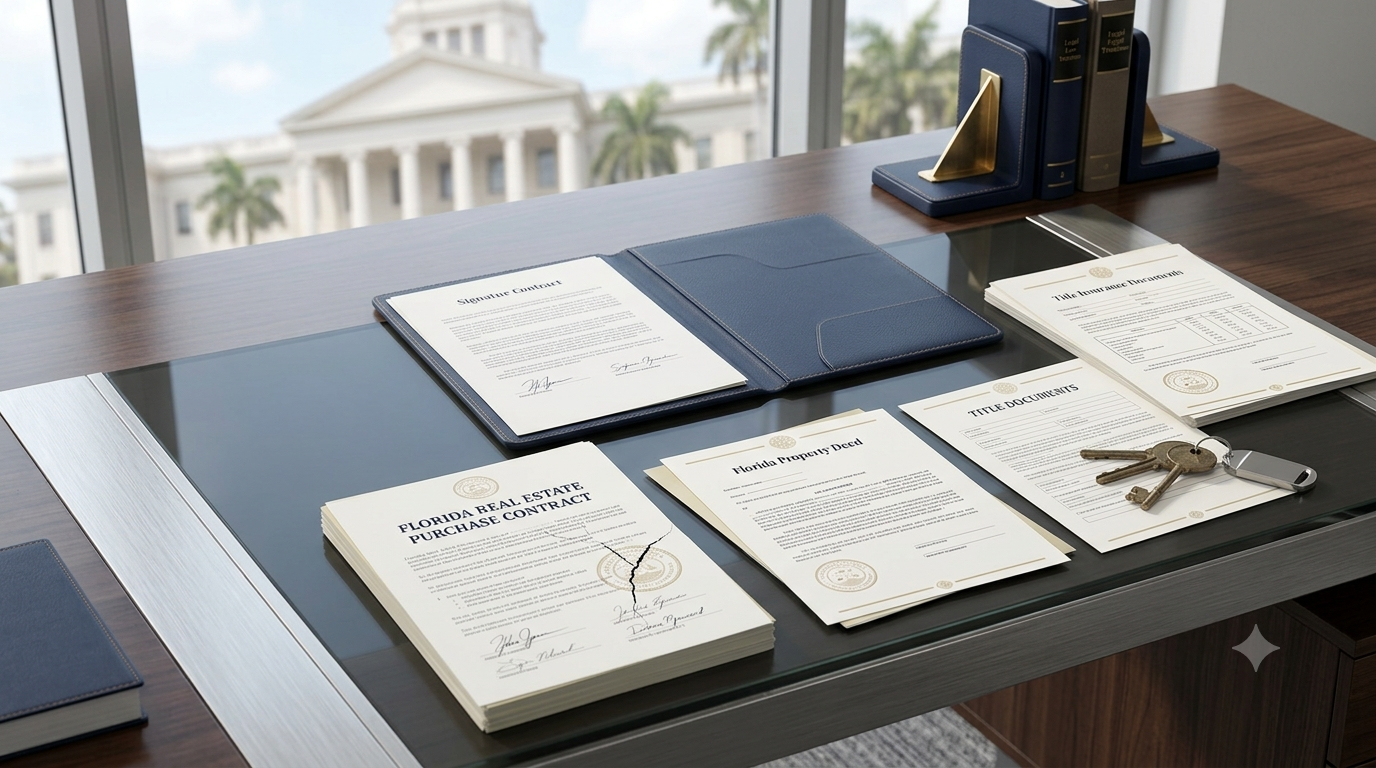
A signed real estate contract creates legal obligations for both the buyer and the seller. When one party refuses to close, misses an important deadline, fails to disclose a title problem, or otherwise does not perform as promised, the dispute may become a breach of real estate contract in Florida.
These disputes can place substantial money and valuable property rights at risk. A buyer may face the loss of a deposit or a property they expected to purchase. A seller may lose time, carrying costs, and the opportunity to accept another offer. In commercial transactions, a failed deal may also disrupt financing, development plans, leases, or business operations.
Florida real estate contracts frequently contain detailed provisions governing deposits, inspections, financing, title, closing, defaults, and remedies. The language of the signed agreement often determines what constitutes a breach and what options may be available.
At Law Offices of Lance Denha, PA, we assist buyers, sellers, investors, property owners, and businesses with real estate contract disputes throughout Florida. This guide explains how breaches occur, the remedies that may be available, and why prompt legal review is important.
Quick Answer
A breach of a real estate contract in Florida occurs when a buyer, seller, or other contracting party fails to perform a material obligation required by a valid property agreement without a legally recognized excuse. Depending on the contract and circumstances, possible remedies may include deposit recovery, liquidated damages, compensatory damages, specific performance, contract termination, or negotiated resolution.
Key Takeaways
- Florida contracts for the sale of real property generally must be in writing and signed to be enforceable.
- Not every mistake or delay constitutes a material breach.
- The contract’s default and remedy provisions are central to the dispute.
- Buyers and sellers may have different remedies.
- A party seeking relief may need to show that it performed—or was ready, willing, and able to perform—its own contractual duties.
- Specific performance may be requested in qualifying cases, but it is not automatically granted.
- Liquidated-damages clauses can affect what compensation may be recovered.
- Parties should preserve contracts, notices, emails, financial records, inspection documents, and evidence of readiness to close.
- Acting before contractual notice or cure deadlines expire can protect more options.
What Is a Breach of Real Estate Contract in Florida?
A breach of real estate contract in Florida generally occurs when one party fails to perform an enforceable contractual duty.
Real estate contracts may involve:
- Residential purchases and sales
- Commercial property transactions
- Vacant land
- Investment property
- Condominium units
- Development agreements
- Assignments
- Lease-purchase arrangements
- Option contracts
- Property exchanges
A breach may occur before closing, at closing, or after the transaction is completed.
For example, a buyer may fail to provide the required deposit, pursue financing as promised, or close by the contractual deadline. A seller may refuse to convey the property, fail to resolve title defects, or sell the property to someone else despite an existing agreement.
Florida’s Statute of Frauds generally requires a contract for the sale of land, or a sufficient written memorandum of the agreement, to be in writing and signed by the party against whom enforcement is sought. This requirement makes the contents of the written agreement especially important when a dispute develops.
What Must Be Proven in a Contract Claim?
Although the exact issues depend on the claim and contract, a breach-of-contract dispute commonly requires examination of:
- Whether a valid contract existed
- What obligations the contract imposed
- Whether the claimant performed or was excused from performing
- Whether the other party materially breached
- Whether the breach caused legally recoverable damages
A signed contract alone does not establish that one party is entitled to relief. The attorney must review the full transaction, including amendments, notices, disclosures, communications, deposits, inspection results, financing efforts, title documents, and closing preparations.
The party seeking damages may also need to demonstrate its ability and willingness to complete the transaction. Florida’s standard contract instructions state that a buyer seeking damages for a seller’s breach must establish that the buyer was ready, willing, and able to perform. A seller seeking damages for a buyer’s breach must similarly show performance, or the ability to perform, the obligations necessary for closing.
Common Examples of Real Estate Contract Breaches
Buyer Fails to Close
A buyer may breach the contract by refusing or failing to close without a contractual right to cancel.
Common reasons include:
- Changing their mind
- Failing to secure funds
- Missing financing deadlines
- Refusing to sign closing documents
- Failing to deliver the balance of the purchase price
- Attempting to cancel after contingencies expire
- Purchasing another property instead
Whether the failure constitutes a breach depends on the agreement. A financing contingency, inspection provision, title objection, appraisal term, or other clause may give the buyer a valid termination right if the buyer follows the contract correctly.
Seller Refuses to Convey the Property
A seller may breach by refusing to complete the sale after entering into a binding agreement.
This may occur when:
- The seller receives a higher offer.
- The seller changes their mind.
- The seller attempts to impose new terms.
- The seller cannot obtain agreement from another owner.
- The seller transfers the property to someone else.
- The seller fails to sign the deed or closing documents.
Because real property is considered unique, a buyer may sometimes seek an order requiring the seller to complete the transaction. Whether that remedy is available depends on the contract, the buyer’s performance, and equitable considerations.
Failure to Make the Required Deposit
Many Florida purchase agreements require an initial deposit and sometimes an additional deposit by a specified deadline.
A buyer’s failure to deliver the deposit may constitute a default. However, the consequences depend on:
- The language of the agreement
- Whether the deadline was extended
- Whether notice and an opportunity to cure were required
- Whether the seller waived strict compliance
- Whether the parties continued performing despite the missed deadline
The parties should not assume that a late payment automatically terminates the agreement without reviewing the relevant provisions.
Financing-Contingency Disputes
A financing contingency may allow a buyer to cancel when financing cannot be obtained, but these provisions commonly impose detailed obligations.
The buyer may be required to:
- Apply by a stated deadline
- Seek a particular loan type or amount
- Act diligently
- Provide lender information
- Notify the seller within a defined period
- Deliver written cancellation before the contingency expires
A buyer who makes little effort to obtain financing or misses the cancellation deadline may have difficulty relying on the contingency later.
Inspection and Repair Disputes
Inspection clauses are frequent sources of conflict.
Disputes may involve:
- Whether the buyer cancelled on time
- Whether a defect falls within the inspection provision
- Whether the seller agreed to make repairs
- Whether completed repairs satisfy the agreement
- Whether the buyer waived the inspection contingency
- Whether an “as-is” clause affects available remedies
An “as-is” contract does not necessarily resolve every possible dispute. The contract, disclosures, alleged representations, and facts discovered during due diligence must be reviewed together.
Title Defects
A seller may be unable to provide the quality of title required by the agreement because of:
- Mortgages
- Judgment liens
- Association liens
- Tax claims
- Probate issues
- Errors in prior deeds
- Unknown ownership interests
- Boundary conflicts
- Easements
- Restrictions
- Pending litigation
The agreement may provide a title-objection period and give the seller time to cure qualifying defects. A buyer who fails to object within the contractual period may lose certain rights.
A seller who cannot cure title may have termination or refund obligations. In other circumstances, the buyer may choose to accept the title condition or pursue additional relief.
Failure to Disclose a Material Property Condition
A dispute may arise when a buyer claims that the seller withheld information about a serious property problem.
Examples include:
- Water intrusion
- Roof leaks
- Structural damage
- Unpermitted work
- Repeated flooding
- Mold
- Septic or plumbing failures
- Boundary disputes
- Association violations
- Known insurance-related problems
The available claims depend on what the seller knew, what was disclosed, what the buyer discovered, the contract language, and whether the alleged issue was readily observable.
Missed Contract Deadlines
Real estate agreements contain deadlines for:
- Deposits
- Financing applications
- Inspections
- Loan approval
- Appraisals
- Association applications
- Title objections
- Closing
- Notices
- Cure periods
A missed deadline can have serious consequences. However, not every delay automatically ends the contract. The parties’ conduct may raise questions involving extensions, waiver, notice, or substantial performance.
Is Every Contract Violation a Material Breach?
No. A minor error does not always justify terminating the entire transaction.
A material breach is generally a failure serious enough to defeat an essential purpose of the agreement or deprive the other party of a substantial contractual benefit.
For example, a minor administrative delay may be treated differently from a complete refusal to close. The analysis may consider:
- The importance of the obligation
- The length of the delay
- Whether the breach can be cured
- The harm caused
- The parties’ prior conduct
- Whether the contract makes time essential
- Whether notice was provided
- Whether the nonbreaching party continued accepting performance
A party who improperly terminates over a minor or curable problem may create its own exposure. Legal advice should be obtained before declaring default or cancelling the agreement.
What Remedies May Be Available?
The available remedy depends on the contract, the breach, the party seeking relief, and the surrounding circumstances.
Return of the Deposit
A buyer may seek return of an earnest-money deposit when the contract was properly cancelled under an inspection, financing, title, or other contingency.
The seller may dispute the refund by claiming that the buyer:
- Missed the cancellation deadline
- Failed to comply with the contingency
- Did not act diligently
- Defaulted for another reason
- Improperly terminated the agreement
The escrow holder may be unable to release disputed funds without joint instructions, a court order, or another authorized resolution process.
Liquidated Damages
Some contracts allow the seller to retain the buyer’s deposit as liquidated damages if the buyer defaults.
Liquidated damages are intended to establish compensation in advance when actual loss may be difficult to determine. Whether a clause controls the dispute depends on the specific language and enforceability of the provision.
A liquidated-damages clause may also limit the seller’s ability to pursue additional damages. The complete remedy section must therefore be reviewed before deciding how to proceed.
Florida’s standard instructions regarding seller damages state that the ordinary damages instruction does not apply where an enforceable liquidated-damages provision governs the claim.
Compensatory Damages
Compensatory damages are intended to address losses legally caused by the breach.
Depending on the claim, contract, and evidence, disputed damages might involve:
- Difference between the contract price and market value
- Certain title-examination expenses
- Additional carrying costs
- Other losses contemplated by the agreement
- Consequential losses meeting applicable legal requirements
A seller’s potential damages may include the difference between the contract sales price and the property’s fair market value at the time of breach, less amounts already paid, when the applicable legal requirements are met and an enforceable liquidated-damages clause does not control.
A buyer’s potential damages can involve the return of purchase money and reasonable title-examination expenses. Additional market-based damages may become relevant where legally sufficient evidence of seller bad faith or a sale to another party exists.
Damages must be supported with evidence and cannot be based only on speculation.
Specific Performance
Specific performance is an equitable remedy asking the court to require a party to perform the contract rather than merely pay damages.
A buyer may seek specific performance when a seller refuses to convey a particular property. A seller may also pursue specific performance in some circumstances, although the availability and practicality of that remedy require careful analysis.
A claimant generally must show that:
- An enforceable agreement exists.
- The material terms are sufficiently definite.
- The claimant performed or was ready, willing, and able to perform.
- The opposing party failed to perform.
- Equitable relief is appropriate.
Specific performance is not automatic. Courts may consider fairness, feasibility, contract clarity, delay, the claimant’s conduct, and other equitable factors.
Contract Termination or Rescission
One party may seek to terminate the contract and restore the parties to their prior positions.
Rescission is different from an ordinary cancellation and is not available in every breach case. It may depend on circumstances involving fraud, mistake, material misrepresentation, failure of consideration, or another recognized basis.
Declaratory or Injunctive Relief
A party may seek a judicial determination of contractual rights or an order preventing conduct that could impair the disputed property interest.
For example, a buyer claiming an enforceable right to purchase may seek relief intended to prevent transfer of the property while the dispute is pending. The availability of such relief depends on the facts and legal requirements.
Negotiated Resolution
Many real estate contract disputes are resolved without a final trial.
A negotiated solution might include:
- Extending the closing date
- Adjusting the purchase price
- Completing specified repairs
- Providing a closing credit
- Releasing some or all of the deposit
- Resolving a title issue
- Terminating the agreement by mutual release
- Reimbursing agreed expenses
- Revising financing or possession terms
Settlement can reduce uncertainty and expense, but the agreement should clearly resolve deposit rights, claims, releases, deadlines, and remaining obligations.
What Should a Buyer Do After a Seller Breaches?
A buyer should avoid immediately signing another agreement or abandoning the transaction without understanding the existing contract.
Useful initial steps include:
- Preserve the signed contract and all addenda.
- Save emails, text messages, notices, and broker communications.
- Document financing approval and available funds.
- Preserve inspection, appraisal, and title records.
- Confirm whether the buyer remained ready to close.
- Review all notice and cure requirements.
- Avoid missing remaining contractual deadlines.
- Seek legal guidance before sending a default or termination notice.
A buyer seeking the property itself may need to act quickly to protect that position.
What Should a Seller Do After a Buyer Breaches?
A seller should not automatically retain the deposit, relist the property, or pursue another buyer without reviewing the contract.
The seller should consider:
- Whether the buyer had a valid termination right
- Whether the buyer missed a contingency deadline
- Whether proper default notice is required
- Whether a cure period applies
- Whether liquidated damages are the exclusive remedy
- Whether the seller was prepared to close
- Whether relisting may affect the damages analysis
- Whether the dispute can be resolved through a written release
A claimant generally has a duty to take reasonable steps to avoid unnecessary additional loss. Florida contract instructions recognize mitigation as a possible defense to damages that could reasonably have been avoided.
Evidence to Preserve
Real estate contract disputes are document-intensive. Preserve:
- Original contract
- All addenda and amendments
- Deposit receipts
- Escrow correspondence
- Loan applications and lender notices
- Proof of funds
- Inspection reports
- Repair requests
- Appraisal
- Title commitment
- Survey
- Association documents
- Seller disclosures
- Emails and text messages
- Default and termination notices
- Proposed closing statement
- Evidence of expenses
- Evidence of market value
- Communications with brokers and closing agents
Avoid editing or deleting electronic messages. Create a clear timeline showing what happened and when.
How a Florida Real Estate Attorney Can Help
A Florida real estate attorney can review the agreement and determine how the default, notice, cure, contingency, deposit, and remedy provisions interact.
Legal assistance may include:
- Determining whether a material breach occurred
- Evaluating whether a cancellation was valid
- Preparing a notice of default
- Responding to a demand
- Addressing an escrow dispute
- Negotiating an extension or settlement
- Evaluating damages
- Seeking or defending specific performance
- Handling title-related issues
- Filing or defending litigation
- Protecting business interests in commercial transactions
For information about the firm’s broader property services, visit Real Estate Law. When a dispute involves an LLC, commercial asset, partnership, or business-owned property, the firm’s Business Law services may also be relevant.
Frequently Asked Questions
What is considered a breach of a real estate contract in Florida?
A breach occurs when a party fails to perform a material contractual obligation without a valid contractual or legal excuse. Examples include refusing to close, failing to pay the deposit, missing a required deadline, or failing to provide the promised title.
Can a buyer back out of a Florida real estate contract?
A buyer may be able to cancel under an inspection, financing, title, condominium-document, or other contingency if the contractual requirements and deadlines are satisfied. A buyer who cancels without a valid right may be in default.
Can a seller back out after signing a contract?
A seller generally cannot cancel merely because a better offer appears or the seller changes their mind. The seller’s rights depend on the contract and whether the buyer has defaulted or another termination provision applies.
Can a buyer force a seller to complete the sale?
A buyer may seek specific performance in an appropriate case. The buyer normally must establish an enforceable contract, compliance or readiness to comply, seller breach, and entitlement to equitable relief.
Can the seller keep the buyer’s deposit?
The answer depends on the default and remedy provisions. Some contracts permit retention of the deposit as liquidated damages following buyer default. A disputed deposit generally should not be released without following the applicable contract and escrow procedures.
Can a seller sue a buyer for more than the deposit?
Possibly. The answer depends on whether the contract makes liquidated damages the exclusive remedy, whether the clause is enforceable, and what other relief the agreement permits.
How are damages calculated?
Damage calculations vary. Relevant factors may include the contract price, fair market value at breach, amounts paid, title expenses, foreseeable losses, liquidated-damages provisions, and mitigation.
Does the contract need to be in writing?
Florida’s Statute of Frauds generally requires contracts for the sale of real property to be written and signed by the party against whom enforcement is sought.
Should I send a default notice myself?
A poorly worded or premature notice can affect contractual rights. Because the agreement may impose precise notice and cure requirements, legal review before sending the notice is advisable.
How long do I have to bring a claim?
The applicable deadline depends on the type of contract, claim, events, and other legal factors. Do not assume that the general limitation period is the only deadline. Contractual notices, cure periods, closing dates, and equitable-delay issues may require much earlier action.
Why Choose Law Offices of Lance Denha, PA?
A real estate contract dispute can affect a deposit, ownership opportunity, investment strategy, or the ability to sell valuable property. Resolving it requires close attention to the written agreement and the evidence surrounding performance.
Law Offices of Lance Denha, PA assists Florida buyers, sellers, investors, property owners, and businesses with:
- Real estate contract disputes
- Failed purchases and sales
- Deposit and escrow disputes
- Title problems
- Specific-performance claims
- Residential and commercial transactions
- Property litigation
- Business-related real estate matters
The firm provides practical legal analysis based on the agreement and circumstances rather than making unsupported promises about outcomes.
To discuss a potential breach of real estate contract in Florida, call Law Offices of Lance Denha, PA at 844-410-4415.
Conclusion
A breach of real estate contract in Florida can arise from a failed closing, missed deadline, financing issue, title problem, deposit dispute, refusal to sell, or another failure to perform.
The most important document is usually the signed contract. Its contingency, notice, cure, default, deposit, and remedy provisions can determine what happens next. Buyers and sellers should avoid declaring default, releasing escrow funds, relisting property, or abandoning a transaction without first understanding those provisions.
Prompt legal review can help preserve evidence, clarify whether a material breach occurred, calculate potential damages, and evaluate remedies such as deposit recovery, liquidated damages, negotiated settlement, or specific performance.
For guidance concerning a Florida real estate transaction or dispute, contact Law Offices of Lance Denha, PA at 844-410-4415.
This article provides general information and is not legal advice for any specific transaction or dispute. Reading it does not create an attorney-client relationship.
