
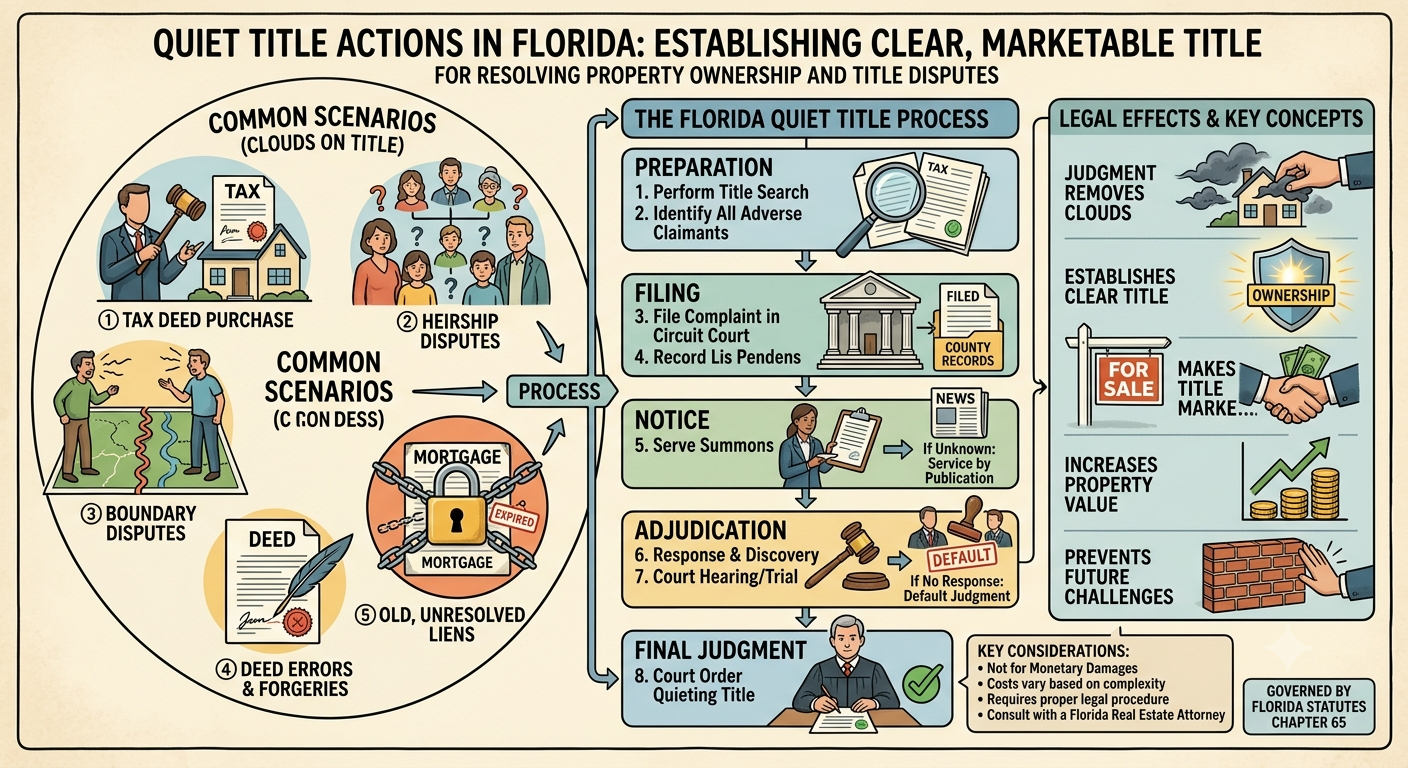
A title problem can prevent a Florida property owner from selling, refinancing, developing, transferring, or fully enjoying real estate. Even when someone believes they are the rightful owner, an old deed, an unreleased lien, an inheritance issue, a competing ownership claim, or a recording error may create uncertainty in the public record.
A quiet title action may provide a legal solution.
Quiet title actions in Florida are court proceedings used to determine ownership rights and remove certain adverse claims or “clouds” affecting real property. When successful, the court enters a judgment identifying the valid ownership interest and eliminating the title issue addressed in the lawsuit.
These cases can arise from tax deed purchases, defective deeds, estate transfers, fraudulent conveyances, boundary disagreements, unreleased mortgages, and many other circumstances. Because every title dispute depends on the recorded documents, ownership history, parties involved, and nature of the competing claim, property owners should have the situation carefully evaluated before filing a lawsuit.
This guide explains what a Florida quiet title action is, when one may be needed, how the process generally works, and what property owners should consider before proceeding.
What Is a Quiet Title Action in Florida? How can Attorney Lance Denha help?
A quiet title action is a lawsuit filed to establish a party’s legal or equitable interest in real property and resolve claims that interfere with that interest.
The word “quiet” does not mean that the case is confidential or uncontested. Instead, it refers to quieting or eliminating competing claims so the owner’s title is no longer subject to the dispute addressed by the judgment.
Chapter 65 of the Florida Statutes authorizes Florida courts to determine competing interests in land and remove clouds from title. Florida law permits a person or corporation claiming legal or equitable title to bring an action against another party that appears to have or asserts an adverse interest in the property.
A successful quiet title action may result in a judgment that:
- Confirms the plaintiff’s ownership interest
- Determines whether another party’s claim is valid
- Removes a defective or invalid recorded interest
- Cancels certain instruments that improperly affect title
- Establishes a clearer chain of ownership
- Makes the property easier to sell, finance, insure, or transfer
- Awards possession when legally appropriate
The specific relief available depends on the facts, the claims pleaded, and the evidence presented.
What Is a Cloud on Title?
A cloud on title is a document, claim, lien, defect, or other issue that creates uncertainty about who owns a property or what rights affect it.
The cloud does not always represent a legally valid ownership interest. In many cases, the problem arises because an instrument appears in the public record and must be legally addressed before a title company, buyer, or lender will accept the title.
Common examples include:
- An improperly executed deed
- A deed containing an incorrect legal description
- A forged or allegedly fraudulent deed
- An unreleased mortgage
- An old lien that appears to remain enforceable
- Conflicting deeds involving the same property
- A claim by an heir or former owner
- A break in the chain of title
- A tax deed ownership issue
- An unknown ownership interest
- A recorded document signed without proper authority
- A dispute involving an easement or property boundary
- A deed involving a dissolved corporation or deceased owner
A property owner may not discover the problem until attempting to sell or refinance the property. A title search may reveal an instrument or claim that must be resolved before the transaction can close.
When Is a Quiet Title Action Needed in Florida?
A quiet title action may be appropriate when a genuine title issue cannot be resolved through a corrective deed, release, affidavit, probate proceeding, settlement, or another less complicated method.
Not every title defect requires litigation. Some problems can be corrected voluntarily when all necessary parties cooperate. For example, a former lender may execute a satisfaction of mortgage, or a prior owner may sign a corrective deed.
Litigation may become necessary when:
- The other party refuses to sign a corrective document
- The claimant cannot be located
- The claimant is deceased
- Multiple heirs may have inherited an interest
- The parties disagree about ownership
- A deed is alleged to be fraudulent or invalid
- A tax deed purchaser needs to establish marketable title
- The public record contains conflicting ownership instruments
- The title insurer will not insure the property without a judgment
- A sale or refinance cannot proceed because of the defect
An attorney reviewing a possible quiet title case may examine the deeds, title commitment, property records, probate documents, mortgages, liens, surveys, tax records, and other evidence affecting ownership.
Legal Requirements for a Florida Quiet Title Claim
A plaintiff cannot prevail merely by alleging that another person’s claim is unfair or inconvenient.
In a March 25, 2026 decision, Florida’s Fourth District Court of Appeal explained that a plaintiff pursuing a quiet title claim must show that:
- The plaintiff has legal title to the property;
- Another entity has an invalid claim to the title; and
- That invalid claim creates a cloud on the plaintiff’s title.
The court also reaffirmed that a party generally must hold title before bringing a traditional quiet title claim: without title, there is nothing to quiet.
Florida Statutes section 65.061 also requires a plaintiff, in many cases, to explain or “deraign” the chain of title from the original source or for at least seven years before filing, unless the court directs otherwise or the parties claim through a common source. The statute calls for recorded instruments affecting title to be identified by their recording information when available.
This means that the plaintiff should be prepared to demonstrate:
- The legal basis of the plaintiff’s ownership
- The chain of instruments supporting that ownership
- The identity of the adverse claimant
- The exact nature of the adverse interest
- Why the adverse claim is invalid or inferior
- How the claim affects the marketability or certainty of title
- The precise property involved, usually through its legal description
The complaint must do more than state that title is “clouded.” It should identify the specific instrument, claim, lien, deed, or interest that creates the alleged cloud.
Common Reasons for Filing Quiet Title Actions in Florida
Defective Deeds
A deed may contain a defect involving signatures, witnesses, acknowledgments, authority, delivery, recording, or the legal description.
Florida law specifically recognizes circumstances in which a person claiming equitable ownership may seek to remove a cloud caused by certain defects in the execution of a deed or mortgage.
Some defects may be corrected without litigation. Others require a court to determine whether the instrument conveyed a valid interest.
Conflicting Deeds
Two different deeds may appear to convey the same property to different people. This can happen because of fraud, clerical errors, duplicate transfers, family disputes, or transactions involving people who lacked authority to convey the property.
A court may need to examine when each deed was executed and recorded, whether consideration was exchanged, whether the parties had notice of competing interests, and whether the person signing had legal authority.
Unreleased Mortgages or Liens
A mortgage may have been paid years earlier but never properly satisfied in the public record. Similarly, an old judgment lien or other encumbrance may appear to affect the property even when the owner believes it is no longer enforceable.
Depending on the facts, the owner may pursue a recorded satisfaction, statutory remedy, declaratory relief, or quiet title claim.
Inheritance and Probate Problems
Real estate may pass through several generations without a properly administered probate estate. The public record may continue listing a deceased owner while multiple heirs claim interests in the property.
A quiet title action alone may not replace necessary probate proceedings. However, it may become part of a broader strategy to resolve ownership after the proper heirs and estate interests have been identified.
Fraudulent or Forged Conveyances
A fraudulent deed can create a serious cloud on title. Florida Statutes section 65.091 expressly permits an action to quiet title based on an allegedly fraudulent attempted conveyance. When the court finds that property was fraudulently conveyed away from a person who held legal title, the statute directs the court to restore the plaintiff’s prior title and rights.
Fraud-based cases frequently require additional claims and carefully developed evidence. A person alleging forgery, identity theft, undue influence, or fraudulent inducement may need to pursue relief beyond a basic quiet title count.
Tax Deed Purchases
Purchasing property at a tax deed sale does not always guarantee that the purchaser will immediately receive insurable or marketable title.
Florida Statutes section 65.081 provides a specific quiet title remedy for tax deed grantees and certain successors in title. The necessary parties may include the former record owner and others claiming interests or liens that existed before the tax deed was issued.
Tax deed cases involve specialized notice, service, and title issues. A purchaser should have the title reviewed before attempting to sell, improve, or finance the property.
Boundary and Legal Description Disputes
An incorrect legal description may place the wrong parcel, portion of land, or boundary in a deed. Surveys may also reveal overlaps, gaps, encroachments, or inconsistencies between recorded descriptions.
Depending on the dispute, the owner may need a surveyor, title professional, and real estate attorney. Some boundary matters may involve claims for reformation, declaratory relief, adverse possession, ejectment, or an injunction in addition to quiet title relief.
Claims by Former Owners or Family Members
Informal property arrangements often lead to disputes. A parent may place a child on a deed for convenience, one family member may pay expenses without being listed as an owner, or relatives may disagree about whether a deed was intended as a gift or temporary security.
A quiet title claim depends on existing legal or equitable ownership. Other remedies, such as a constructive trust, deed reformation, rescission, or a claim based on fraud, may be needed when the plaintiff is not the record titleholder.
How Does a Quiet Title Action Work in Florida?
Although every case is different, the process commonly includes the following stages.
1. Title Examination and Investigation
The first step is determining exactly what affects the property.
This may require reviewing:
- The current deed
- Prior deeds
- The title search or title commitment
- Recorded mortgages and satisfactions
- Judgments and liens
- Probate records
- Tax records
- Corporate records
- Surveys and legal descriptions
- Divorce judgments
- Death certificates
- Affidavits
- Purchase and sale agreements
- Communications between the parties
The investigation helps identify the correct defendants and determine whether quiet title is the proper remedy.
2. Identifying All Necessary Parties
A quiet title judgment generally does not bind a person who was not made a party to the action. Florida Statutes section 65.041 specifically states that a person who is not a party is not bound by a judgment adverse to that person’s interest.
For that reason, identifying and serving every necessary claimant is one of the most important parts of the case.
Potential defendants may include:
- Former owners
- Heirs and beneficiaries
- Lenders
- Lienholders
- Business entities
- Trustees
- Tax deed interest holders
- Homeowners’ or condominium associations
- Governmental entities
- Unknown spouses
- Unknown heirs
- Any person appearing to claim an interest
Failing to include a necessary party may leave the title problem unresolved.
3. Filing the Complaint
The lawsuit is generally filed in the circuit court for the county in which the property is located. The complaint should include the legal description, the basis of the plaintiff’s title, the adverse claim, and the relief requested.
Depending on the facts, the complaint may include additional counts for:
- Declaratory judgment
- Deed reformation
- Cancellation of an instrument
- Constructive trust
- Fraud
- Ejectment
- Partition
- Adverse possession
- Injunctive relief
- Damages
Combining claims should be based on the legal and factual circumstances, not merely on a desire to add more allegations.
4. Serving the Defendants
Known defendants must be served in accordance with applicable procedural rules.
When a claimant’s identity or location is unknown, constructive service by publication may sometimes be available after legally required efforts are made to identify or locate the person. Publication is not automatically sufficient in every case. The method of service must satisfy Florida law and constitutional due-process requirements.
Improper service can make a judgment vulnerable to a later challenge.
5. Responses, Discovery, and Motions
A defendant may admit the allegations, default, file a motion to dismiss, assert defenses, or claim an ownership interest.
Contested cases may involve:
- Written discovery
- Depositions
- Document subpoenas
- Expert testimony
- Surveys
- Handwriting analysis
- Motions for summary judgment
- Mediation
- Trial
The complexity depends largely on whether the adverse parties cooperate and whether the underlying facts are disputed.
6. Final Judgment
If the plaintiff proves the claim, the court may enter a final judgment removing the specified cloud and quieting title in the plaintiff or otherwise determining the parties’ interests.
Under section 65.061, the final judgment may be recorded in the county where the property is located and can operate to vest title in a manner similar to a conveyance.
Recording the judgment is an important final step because the public property records should reflect the court’s determination.
How Long Does a Quiet Title Action Take in Florida?
There is no single deadline that applies to every quiet title case.
An uncontested case may move more quickly when:
- The defendants can be identified and served
- No party disputes the plaintiff’s ownership
- The title history is straightforward
- The legal description is accurate
- No additional claims are required
A contested case may take considerably longer when:
- Multiple parties claim ownership
- Heirs must be identified
- Defendants cannot be located
- Service by publication is required
- Fraud or forgery is alleged
- The chain of title is complicated
- Surveys or expert opinions are needed
- Motions or appeals are filed
Court schedules, procedural disputes, and settlement discussions can also affect the timeline.
Property owners should be cautious about relying on a guaranteed completion date, particularly when a pending sale depends on the outcome.
Can a Quiet Title Action Remove a Valid Mortgage or Lien?
A quiet title lawsuit does not automatically eliminate a valid mortgage, lien, easement, or ownership interest.
The plaintiff must establish a legal basis for finding that the competing claim is invalid, unenforceable, satisfied, inferior, expired, fraudulent, or otherwise subject to removal.
A court will not generally cancel a valid interest merely because it interferes with a proposed sale or refinance.
Before filing, the owner should determine:
- Whether the debt was actually paid
- Whether the lien remains enforceable
- Whether the claimant received proper notice
- Whether a release or satisfaction is available
- Whether another statutory remedy applies
- Whether title insurance covers the issue
- Whether the dispute can be resolved through settlement
The appropriate remedy depends on the particular instrument and the reason it allegedly should no longer affect the property.
Quiet Title Action Versus Partition Action
A quiet title action determines the validity and priority of ownership claims. A partition action generally addresses what should happen when two or more people already own property together and one or more owners want to divide or sell it.
For example:
- If two deeds create uncertainty about who owns the property, quiet title may be appropriate.
- If siblings agree that they inherited the property but disagree about whether it should be sold, partition may be appropriate.
- If the parties dispute both ownership and disposition, quiet title and partition-related claims may need to be addressed together.
Selecting the correct action is important because the required allegations and available remedies differ.
Quiet Title Action Versus a Corrective Deed
A corrective deed may fix a limited drafting or recording error when the necessary parties agree and are available to sign.
A lawsuit may be necessary when:
- A prior owner refuses to cooperate
- The original grantor is deceased
- Competing claimants exist
- Fraud is alleged
- The correction would affect another party’s rights
- The title company requires a court judgment
- The defect cannot legally be cured through re-recording
Using a corrective instrument without proper authority can create additional title problems. The proposed correction should be reviewed before another document is recorded.
Does Title Insurance Cover Quiet Title Problems?
Title insurance may cover certain losses or provide a defense relating to defects that fall within the policy’s coverage.
Coverage depends on:
- The language of the policy
- The policy date
- Listed exceptions
- Exclusions
- Whether the defect existed when the policy was issued
- Whether the insured created or knew about the problem
- The type of claim being asserted
A property owner who has an owner’s title insurance policy should promptly notify the insurer after discovering a possible covered defect. The policy may require notice before the owner independently hires counsel, settles the dispute, or takes other action.
Title insurance does not replace legal advice, and not every title issue is covered.
How Much Does a Quiet Title Action Cost?
The cost varies depending on the title history, number of defendants, service requirements, contested issues, necessary research, and additional claims.
Possible expenses include:
- Attorney’s fees
- Court filing fees
- Title search costs
- Service-of-process fees
- Publication expenses
- Certified copies and recording charges
- Surveying fees
- Guardian ad litem fees when legally required
- Expert witness expenses
- Deposition and litigation costs
A straightforward uncontested matter will generally involve fewer resources than a case involving fraud, numerous heirs, disputed possession, or competing deeds.
An attorney should review the available records before providing meaningful guidance regarding anticipated cost.
What Evidence May Be Needed?
Useful evidence may include:
- Recorded deeds
- Closing documents
- Title policies and commitments
- Proof of payment
- Satisfactions and releases
- Probate orders
- Wills and trust documents
- Corporate resolutions
- Powers of attorney
- Property tax records
- Surveys
- Photographs
- Communications between the parties
- Testimony concerning the transfer
- Expert analysis of signatures or documents
The strongest evidence depends on the alleged cloud and the ownership theory being asserted.
Frequently Asked Questions About Quiet Title Actions in Florida
Can I file a quiet title action if I am not on the deed?
A traditional quiet title plaintiff generally must establish legal title. Florida appellate authority states that a person without title ordinarily has nothing to quiet. Depending on the facts, someone claiming equitable ownership may need to pursue constructive trust, reformation, rescission, fraud, or another form of relief.
Can a quiet title action resolve a forged deed?
Potentially. Florida law recognizes quiet title actions based on fraudulent attempted conveyances. Forgery cases may also involve cancellation of the instrument, fraud claims, criminal reports, or other remedies.
Can quiet title remove an heir’s interest?
Only when there is a valid legal basis for determining that the heir has no enforceable interest. All potentially interested heirs should be properly identified and served.
Can a tax deed buyer immediately resell the property?
A tax deed buyer may face title-insurance or marketability concerns. A quiet title action or another recognized title-certification process may be required before a conventional buyer or lender will proceed.
Do all defendants have to agree?
No. A court can decide a contested case after the parties receive proper notice and an opportunity to present their claims.
What happens if a defendant ignores the lawsuit?
The plaintiff may seek a default, but procedural and evidentiary requirements still apply. Proper service is essential. Florida law allows judgment after default under certain circumstances, but the pleadings must support the requested relief.
Will the judgment automatically update the property records?
The final judgment should generally be recorded in the county’s official records. The property owner or attorney should confirm that all necessary post-judgment recording steps have been completed.
Why Legal Review Matters
Quiet title actions are document-intensive real estate lawsuits. A mistake involving the legal description, chain of title, necessary parties, service, or requested relief may delay the case or produce a judgment that does not fully resolve the problem.
Before filing, a Florida real estate attorney can evaluate:
- Whether the client has standing to sue
- Whether quiet title is the correct cause of action
- Whether another remedy should be included
- Which parties must be named
- How each defendant must be served
- Whether title insurance may apply
- What evidence supports the ownership claim
- What risks could affect the case
Early review is especially important when the defect is delaying a closing, refinance, development project, or estate administration.
Speak With a Florida Real Estate Attorney About a Title Dispute
A cloud on title can affect the value, transferability, and use of Florida real estate. Waiting until a scheduled closing to address the issue may lead to delays, additional expenses, or the loss of a transaction.
The Law Offices of Lance Denha, PA assists clients with Florida real estate disputes, including matters involving ownership claims, defective instruments, title issues, and related litigation.
To discuss a Florida property title matter, contact the Law Offices of Lance Denha, PA at 844-410-4415 or submit a consultation request through the firm’s website.
The firm’s Florida office is located at:
200 S Andrews Ave., Suite 604
Fort Lauderdale, FL 33301
Every matter depends on its individual facts, recorded documents, procedural history, and applicable law. Contacting the firm does not guarantee a particular outcome.
This article is provided for general informational purposes and does not constitute legal advice. Reading this article does not create an attorney-client relationship. Florida property owners should obtain advice concerning their particular circumstances.
