
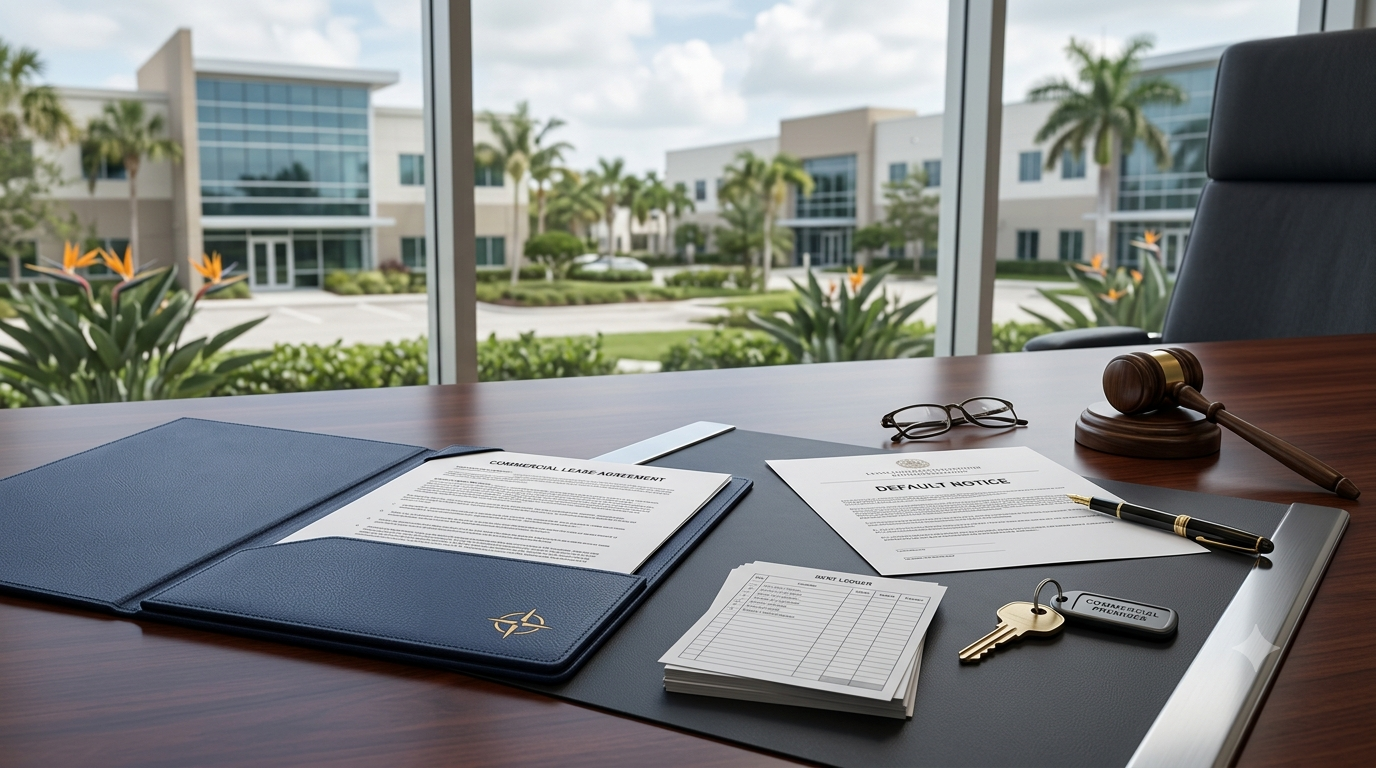
Commercial lease default notice in Florida? If your business has received a written demand involving unpaid rent, a lease violation, termination, surrender of the premises, or a threatened commercial eviction, the issue should be reviewed quickly.
A default notice can be the beginning of a much larger dispute.
The landlord may be seeking unpaid rent, possession of the property, attorney’s fees, damages, enforcement of a personal guarantee, or other remedies provided by the lease and Florida law.
For a business owner, the consequences can go far beyond the lease itself.
Losing commercial premises can affect employees, customers, inventory, equipment, licenses, signage, vendor relationships, and the ability to continue operating.
Florida law treats commercial leases differently from residential tenancies. Chapter 83, Part I applies to nonresidential tenancies and includes specific procedures concerning possession, defaults, notices, rent disputes, and removal of commercial tenants.
If you have received a commercial lease default notice in Florida, these seven steps can help you understand what should be reviewed before responding.
What Is a Commercial Lease Default Notice in Florida?
A commercial lease default notice in Florida is generally a written communication alleging that a business tenant has violated the lease.
The alleged default may involve money or conduct.
Common examples include:
- Unpaid rent
- Late rent
- Failure to pay common-area maintenance charges
- Unpaid taxes or insurance obligations
- Unauthorized use of the property
- Prohibited alterations
- Failure to maintain insurance
- Failure to repair the premises
- Unauthorized assignment or sublease
- Operating outside permitted-use restrictions
- Violation of signage rules
- Abandonment
- Failure to comply with other material lease obligations
The notice may demand payment, correction of the alleged violation, surrender of the premises, or some combination of those remedies.
Do not assume every default notice creates the same deadline.
Commercial lease rights often depend heavily on the actual written lease.
Florida Statutes section 83.20 provides particular statutory notice rules for removal of commercial tenants. For nonpayment of rent, the statute provides for three days’ written notice requiring payment or possession. For certain material non-rent breaches, when the lease itself is silent on the matter, the statute provides a 15-day written notice to cure or surrender possession.
The lease may contain additional provisions that significantly affect what happens next.
1. Read the Commercial Lease Default Notice in Florida Immediately
Do not put the notice aside until the end of the week.
Start by determining exactly what the landlord claims you did wrong.
Identify:
- Date of the notice
- Alleged default
- Amount claimed
- Cure deadline
- Demand for possession
- Method of service
- Lease section referenced
- Whether termination is threatened
- Whether attorney involvement is mentioned
Then compare the notice against the lease.
A landlord may allege that $40,000 is due.
That number could include:
- Base rent
- Additional rent
- CAM charges
- Taxes
- Insurance
- Late fees
- Interest
- Repair expenses
- Other lease charges
Whether each charge qualifies as rent or is otherwise recoverable may depend on the agreement.
A business owner who receives a commercial lease default notice in Florida should therefore avoid reacting to the total amount alone.
The legal analysis begins with the lease.
2. Review the Cure Provision in the Commercial Lease
Commercial leases often contain detailed default-and-cure sections.
Those provisions may answer questions such as:
- How much time does the tenant have to cure?
- Is written notice required?
- Where must notice be sent?
- Does nonpayment receive a shorter cure period?
- Does a repeated breach receive another cure period?
- Can certain defaults be cured at all?
- Is termination automatic after the cure deadline?
- Does acceptance of partial payment affect remedies?
This is especially important because Florida’s statutory rules can interact with the lease itself.
For nonpayment of commercial rent, section 83.20(2) permits removal after default and written three-day notice demanding rent or possession.
For a material breach other than nonpayment, section 83.20(3) provides a 15-day cure-or-possession notice when the lease is silent on the issue. The statute expressly states that this subsection applies when the lease does not address the matter or the tenancy is oral.
That means the written lease may be critical.
A commercial lease default notice in Florida should be reviewed together with the lease’s default section, notice provision, rent definition, remedies provision, and any amendments.
3. Determine Whether the Amount Claimed Is Actually Correct
Commercial rent disputes are frequently accounting disputes.
The landlord may say the tenant owes one amount.
The tenant’s records may show another.
Possible differences can involve:
- Base rent increases
- CAM reconciliations
- Property tax adjustments
- Insurance charges
- Percentage rent
- Late fees
- Credits
- Security deposit applications
- Payments posted incorrectly
- Rent abatements
- Concessions
- Repairs paid by the tenant
- Prior settlement arrangements
If you receive a commercial lease default notice in Florida based on nonpayment, obtain a complete landlord ledger.
Compare it against:
- Bank statements
- Cancelled checks
- ACH confirmations
- Wire records
- Accounting software
- Email confirmations
- Prior invoices
- Lease amendments
- CAM statements
- Tax reconciliations
Do not rely only on memory.
A dispute involving $5,000 of base rent may become a $25,000 claim once additional charges are included.
Conversely, a landlord’s ledger may fail to reflect payments or credits.
What If You Dispute the Rent Amount?
If a commercial eviction lawsuit is filed and the landlord seeks possession, Florida Statutes section 83.232 can create a significant procedural requirement.
The tenant generally must deposit alleged unpaid rent into the court registry, or if the amount is disputed, the amount determined by the court, subject to the statutory procedures.
This makes early legal advice especially important.
A commercial tenant should not assume that simply disputing the landlord’s accounting means no rent must be deposited.
Failure to comply with a court order requiring registry payments can result in an absolute waiver of defenses and immediate default for possession.
4. Determine Whether the Landlord Also Breached the Lease
Commercial lease disputes are not always one-sided.
A tenant may argue that the landlord also failed to perform.
Possible issues might involve:
- Failure to make required structural repairs
- Failure to provide required services
- Access problems
- Water intrusion
- HVAC obligations
- Roof problems
- Code issues
- Interference with parking
- Failure to maintain common areas
- Problems with utilities
- Failure to deliver agreed improvements
But tenants should be extremely careful before withholding commercial rent.
Florida Statutes section 83.201 addresses a narrow situation where a commercial tenant may withhold rent when the lease places a repair or maintenance obligation on the landlord, the lease is silent on the procedure, and the failure renders the premises wholly untenantable. The tenant must provide written notice giving the landlord at least 20 days to perform the specified repairs before withholding rent under that statute.
This is not a general rule allowing commercial tenants to stop paying whenever they are unhappy with maintenance.
If a commercial lease default notice in Florida followed a decision to withhold rent, have the situation reviewed quickly.
The validity of the tenant’s position may depend on:
- Exact lease language
- Condition of the premises
- Notice given
- Timing
- Nature of the landlord’s alleged breach
- Whether the space was actually usable
5. Review Any Personal Guarantee
This is one of the most important financial issues for business owners.
Many commercial leases require an owner, shareholder, member, or principal to personally guarantee the company’s obligations.
That can mean the dispute is not limited to the LLC or corporation.
Potentially, a landlord may pursue the guarantor for obligations covered by the guarantee even if the business closes.
Review:
- Who signed the guarantee
- Whether it is unlimited
- Whether it has a cap
- Whether it burns off over time
- Whether liability changes after assignment
- Whether it covers attorney’s fees
- Whether it covers future rent
- Whether amendments affect the guarantee
- Whether surrender changes liability
A commercial lease default notice in Florida can therefore create personal financial exposure for the business owner as well as operational risk for the company.
Do not assume closing the LLC automatically ends personal liability.
6. Decide Whether Negotiation Is Better Than Litigation
Not every commercial default needs to become an eviction lawsuit.
Sometimes both sides have an economic reason to negotiate.
The landlord may prefer a paying tenant rather than an empty storefront.
The tenant may need time to recover from a temporary cash-flow problem.
Possible negotiated solutions may include:
- Payment plan
- Partial rent deferral
- Temporary rent reduction
- Extension of lease term
- Application of security deposit
- Surrender agreement
- Early termination
- Relocation within the property
- Amendment of use restrictions
- Settlement of disputed CAM charges
- Release of a personal guarantee
- Structured move-out period
A negotiated resolution should be written carefully.
A business owner facing a commercial lease default notice in Florida should not rely on statements such as:
“Just pay half this month and we’ll figure it out later.”
If the landlord agrees to modify the default, obtain documentation.
Important settlement terms can include:
- Exact amount due
- Payment dates
- Whether default is considered cured
- Whether the landlord waives existing claims
- Whether possession rights are suspended
- Whether attorney’s fees are included
- What happens after another missed payment
- Whether the guarantor is released
An informal deal can create a second dispute.
7. Speak With a Florida Commercial Lease Attorney Before the Deadline
Once a default notice is received, timing matters.
A lawyer can review:
- Commercial lease
- Amendments
- Default notice
- Payment records
- Landlord ledger
- Personal guarantee
- Correspondence
- Repair records
- Prior notices
- Business objectives
The goal should be to determine the most practical strategy.
That may involve:
- Curing the default
- Disputing the amount
- Responding to the notice
- Negotiating payment
- Negotiating surrender
- Preserving possession
- Evaluating landlord breaches
- Preparing for litigation
- Defending a commercial eviction
- Addressing personal-guarantee exposure
If you have received a commercial lease default notice in Florida, waiting until an eviction complaint has already been filed can reduce the time available to resolve the dispute commercially.
What Happens If the Landlord Files a Commercial Eviction?
Florida law allows commercial landlords to pursue possession through court proceedings.
Section 83.05 states that a landlord of nonresidential premises may recover possession through an action in which the right to possession is determined, or where the tenant has surrendered or abandoned the property.
If the landlord prevails, Florida law allows judgment for possession.
Where properly requested and supported, the court may also enter a money judgment for unpaid sums, subject to the jurisdiction and service requirements provided by law.
For a business tenant, that means the case can potentially involve both:
Possession of the premises
and
Money owed under the lease.
Those are different risks.
Court Registry Requirements Can Be Critical
Commercial tenants sometimes focus only on their defenses and overlook the court-registry requirement.
That can be a serious mistake.
Under section 83.232, when a landlord’s action includes a claim for possession, the tenant generally must pay alleged unpaid rent into the registry, unless the statutory payment-or-satisfaction defense applies, or deposit the amount determined by the court when the amount is contested.
The statute also provides that a tenant’s counterclaim for money damages does not eliminate the registry requirement.
Failure to make a required registry payment can result in waiver of defenses and immediate default for possession.
This is one of the strongest reasons to obtain legal guidance promptly after a commercial eviction case begins.
Can the Landlord Simply Lock the Business Out?
A landlord should not assume that self-help possession is automatically permitted whenever rent is late.
Florida law provides that a commercial landlord recovers possession through a possession action, surrender, or abandonment.
The lease and factual circumstances still matter.
Business owners facing a lockout, removal of property, utility interference, or access restriction should document what happened and seek advice concerning their specific rights.
Do not respond by forcibly entering property or damaging locks.
What Happens to Equipment and Inventory?
Commercial tenants may have significant property inside the leased premises, including:
- Inventory
- Computers
- Machinery
- Furniture
- Customer records
- Tools
- Point-of-sale systems
- Vehicles
- Equipment
Florida commercial landlord law includes provisions concerning landlord liens and distress for rent, making business-property issues more complicated than simply moving out.
If the tenant intends to surrender premises, the treatment of personal property should be addressed in writing.
A carefully negotiated surrender agreement may address:
- Move-out date
- Equipment removal
- Inventory
- Security deposit
- Keys
- Property condition
- Remaining rent
- Mutual releases
- Personal guarantee
- Attorney’s fees
What If the Business Cannot Afford the Lease Anymore?
Ignoring the landlord is usually not the best strategy.
If revenue has declined and the lease is no longer sustainable, early negotiation may provide more options.
Possible strategies may include:
- Assignment
- Sublease
- Early termination
- Surrender agreement
- Buyout of remaining term
- Reduced rent
- Relocation
Whether those options are available depends on the lease and landlord.
The earlier the tenant addresses the issue, the more opportunity there may be to preserve business value.
Common Mistakes After Receiving a Commercial Lease Default Notice
Ignoring the Notice
The problem rarely disappears.
Paying Only Part of the Amount Without an Agreement
Partial payment may or may not cure the default.
Stopping Rent Because the Landlord Failed to Make Repairs
Florida law imposes specific requirements before commercial tenants may rely on statutory rent-withholding rights for wholly untenantable premises.
Moving Out Without Reviewing the Lease
Vacating does not necessarily eliminate future financial obligations.
Assuming the LLC Protects the Owner
A personal guarantee may create individual liability.
Signing a Surrender Agreement Too Quickly
The document may contain admissions, releases, repayment obligations, or continuing guarantee liability.
Missing Court Registry Requirements
This can have serious consequences in possession litigation.
Frequently Asked Questions About a Commercial Lease Default Notice in Florida
How long does a commercial tenant have to pay unpaid rent?
For nonpayment situations falling under Florida Statutes section 83.20(2), the statute provides a three-day written notice requiring payment or possession. The lease and exact circumstances should still be reviewed.
How long does a tenant have to cure a non-rent violation?
Section 83.20(3) provides a 15-day written cure-or-possession notice for certain material breaches when the lease is silent on the issue. A written lease may establish its own relevant cure provisions.
Can a commercial landlord sue for both eviction and unpaid rent?
Potentially. Section 83.231 allows a court to award possession and, where properly pleaded and supported, a money judgment for amounts found due.
Can I dispute the amount of rent claimed?
Yes, but a commercial eviction action may still require payment into the court registry of an amount determined under section 83.232.
Can I withhold rent because the landlord refuses repairs?
Only under appropriate circumstances. Section 83.201 contains specific requirements where the landlord has an express maintenance obligation, the lease is silent on procedure, and the failure renders the premises wholly untenantable. Written notice and an opportunity to repair are required.
Does moving out eliminate the debt?
Not necessarily. The lease, surrender terms, mitigation issues, damages provisions, and personal guarantees may affect continuing obligations.
Should I contact an attorney after receiving a default notice?
If the notice threatens termination, possession, significant unpaid rent, personal-guarantee liability, or other material consequences, early review can help clarify deadlines and possible options before litigation advances.
How a Florida Commercial Lease Attorney May Help
A lawyer reviewing a commercial lease default notice in Florida may help determine:
- Whether the notice complies with the lease
- Whether the amount claimed is accurate
- Whether the tenant has cure rights
- Whether landlord conduct creates defenses or counterclaims
- Whether a personal guarantee creates individual exposure
- Whether negotiation is practical
- Whether surrender should be considered
- How to respond if an eviction action is filed
- What court registry obligations may apply
For many business owners, the goal is not simply winning a lawsuit.
The goal may be keeping the business open, protecting cash flow, negotiating more time, preserving equipment, resolving a guarantee, or exiting the lease without unnecessary additional liability.
Commercial Lease Default Notice in Florida? Consider Acting Before the Deadline
A commercial lease default notice in Florida can quickly become a dispute involving possession, substantial rent claims, personal guarantees, business interruption, and litigation.
The strongest response usually begins with understanding:
- What the lease requires
- What the landlord claims
- Whether the alleged default is accurate
- What cure rights exist
- Whether rent calculations are correct
- Whether the landlord also failed to perform
- Whether personal liability is involved
- Whether settlement can protect the business
Do not wait until the sheriff, court, or landlord is taking the next step before reviewing the lease.
The Law Offices of Lance Denha, PA assists clients with Florida business law, commercial real estate matters, contracts, and related disputes.
If your company has received a commercial lease default notice, demand for possession, or commercial eviction complaint, consider having the documents reviewed promptly.
Law Offices of Lance Denha, PA
844-410-4415
Every commercial lease dispute depends on the lease language, notice, payment records, property circumstances, procedural history, and applicable law. No particular outcome can be guaranteed.
This article is provided for general informational purposes only and does not constitute legal advice. Reading this article does not create an attorney-client relationship.
