
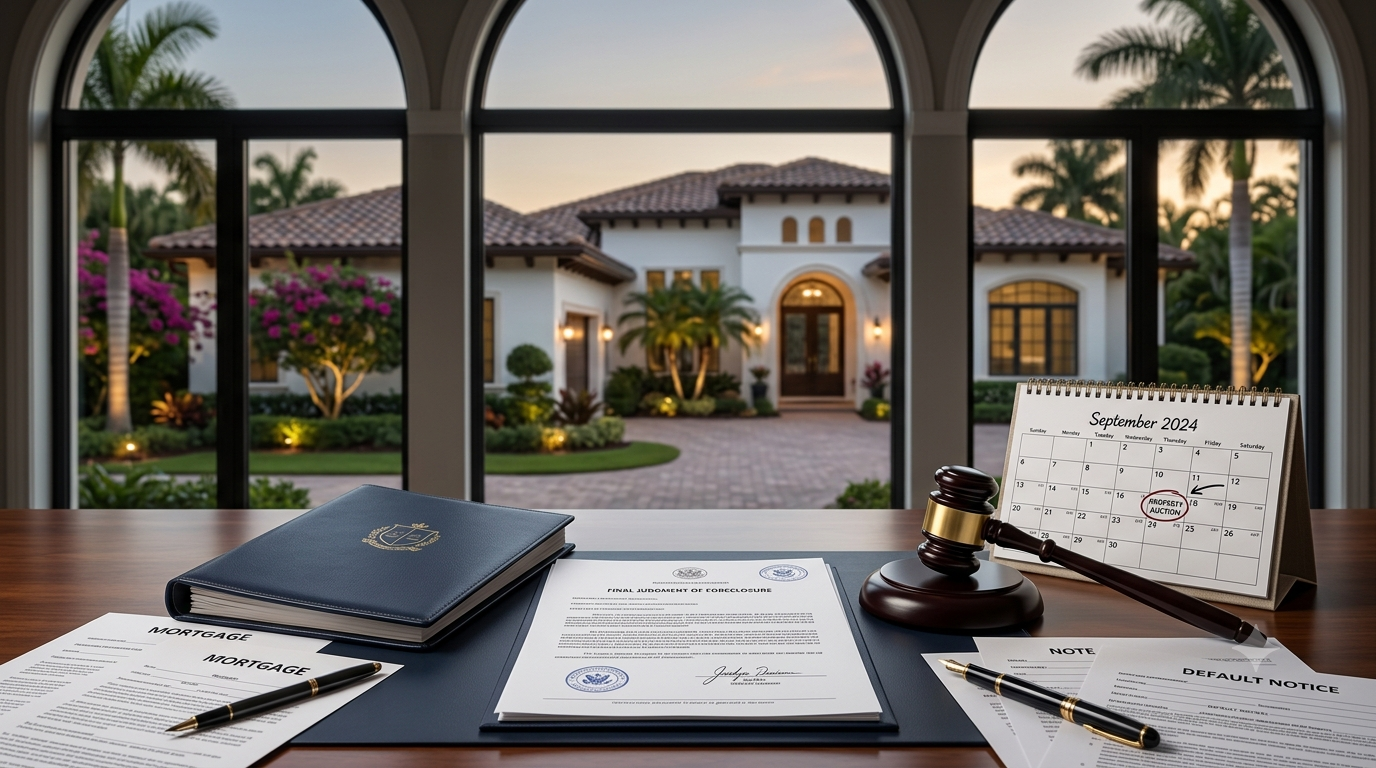
Has a final judgment of foreclosure in Florida been entered against your property? The situation has reached one of the most important stages of the foreclosure process, and the time between the judgment and the scheduled judicial sale may be limited.
A final judgment generally means the court has ruled in favor of the foreclosing plaintiff, determined amounts due under the mortgage, and authorized the property to be sold through a judicial foreclosure sale.
This is different from simply receiving a foreclosure summons.
At the final judgment stage, a homeowner may already have a sale date. Under Florida’s judicial-sale statute, the final judgment generally directs the clerk to sell the property on a specified date between 20 and 35 days after entry of the judgment. However, a later sale may occur if the plaintiff or its attorney consents.
That makes timing extremely important.
A final judgment of foreclosure in Florida does not necessarily mean that every legal or financial option has disappeared. Depending on the facts, homeowners may need to evaluate redemption, a possible property sale, loss mitigation, settlement, bankruptcy advice, appellate issues, or whether there is a legitimate basis to seek court relief.
However, no homeowner should assume that a last-minute request automatically stops a foreclosure sale.
Here are seven issues to review immediately.
What Is a Final Judgment of Foreclosure in Florida?
A final judgment of foreclosure in Florida is a court order resolving the foreclosure claim and generally authorizing the mortgaged property to be sold.
The judgment may state:
- Amount of principal due
- Accrued interest
- Attorney’s fees
- Court costs
- Escrow advances
- Taxes or insurance advances
- Other recoverable amounts
- Legal description of the property
- Priority of liens
- Foreclosure sale date
- Instructions regarding the judicial sale
Florida Statutes §45.031 provides the framework for judicial sales conducted under a judgment or order.
The statute requires the judgment to direct the clerk to sell the property at public sale on a specified date. It also contains statutory notices addressing possible surplus funds following the sale.
The important distinction is that the foreclosure is no longer merely alleged.
A judgment has been entered.
That is why homeowners who want to challenge something about the judgment, preserve equity, pursue redemption, or consider alternatives should treat the matter as urgent.
1. Read the Final Judgment of Foreclosure in Florida Carefully
The first step is obtaining and reading the entire judgment.
Do not rely only on what someone tells you over the telephone.
Review:
- Date the judgment was entered
- Total amount stated as due
- Sale date
- Property description
- Interest calculations
- Attorney’s fees and costs
- Instructions to the clerk
- Redemption language
- Any provisions concerning surplus proceeds
The court docket should also be reviewed.
Important filings may include:
- Foreclosure complaint
- Proof of service
- Your answer
- Affirmative defenses
- Motions
- Affidavits
- Summary judgment papers
- Hearing notices
- Orders entered before judgment
A lawyer reviewing a final judgment of foreclosure in Florida may need the complete procedural history to determine whether there is a meaningful issue to address.
Simply disagreeing with the result is not the same as having a valid legal basis for relief.
2. Confirm the Foreclosure Sale Date Immediately
A final foreclosure judgment normally sets the judicial sale.
Florida Statutes §45.031 states that the court generally directs the sale to occur not less than 20 days and not more than 35 days after the judgment, unless the plaintiff or plaintiff’s lawyer consents to a later date.
This can create a relatively short window.
If a final judgment of foreclosure in Florida has already been entered, confirm:
- Exact sale date
- Exact sale time
- County where the case is pending
- Whether the auction is online
- Whether any later order changed the date
- Whether the lender has sought postponement
- Whether the sale remains active
Do not assume that a loss-mitigation application, phone conversation, pending property listing, or request to the lender has automatically cancelled the auction.
If someone tells you the sale will be postponed, seek written confirmation and verify the court record or official auction status.
Why the Sale Date Changes Everything
Before judgment, a homeowner may have more time to investigate defenses, negotiate, sell the property, or submit financial information.
After judgment, every week can matter.
A property owner who waits until the day before the auction may discover that an option that was realistic several weeks earlier is no longer practical.
3. Determine Whether Florida’s Right of Redemption Is Realistic
Florida law provides an important right known as redemption.
Under Florida Statutes §45.0315, the mortgagor or holder of a subordinate interest may generally cure the indebtedness and prevent the foreclosure sale before the later of the filing of the certificate of sale or the time specified in the foreclosure judgment, order, or decree.
After a final judgment of foreclosure in Florida, redemption typically means paying the amount required under the judgment—not simply making one or two missed monthly payments.
The required amount may include:
- Principal
- Interest
- Court costs
- Attorney’s fees
- Escrow advances
- Taxes
- Insurance
- Other amounts included in the judgment
A homeowner considering redemption should obtain an accurate amount as quickly as possible.
Potential funding sources might include:
- Available cash
- Family assistance
- Refinancing
- Sale proceeds
- Other financing
Whether any of those options are realistic depends on the homeowner’s circumstances.
The key is not to wait until immediately before the sale to begin determining what payment would be necessary.
4. Determine Whether There Is a Legitimate Basis to Seek Court Relief
A common question is:
“Can the final foreclosure judgment be reversed?”
Potentially, but not merely because the homeowner wants additional time.
Florida Statutes §702.07 confirms that Florida circuit courts have authority to rescind, vacate, and set aside foreclosure decrees before the sale has actually occurred.
That statutory authority does not mean a judge must set aside every judgment upon request.
A legally sufficient basis is still necessary.
Issues that may warrant review can include, depending on the facts:
- Improper service
- Default entered under questionable circumstances
- Fraud or misrepresentation
- Payment or satisfaction issues
- Significant procedural problems
- Settlement not reflected in the judgment
- Mistake or other recognized grounds for relief
- Problems involving notice or the proceedings
A lawyer evaluating a final judgment of foreclosure in Florida may need to review the record and evidence before determining whether seeking relief is legally supportable.
What If You Were Never Served?
This deserves prompt attention.
If you first learn about the foreclosure after receiving notice of a judgment or sale, tell counsel immediately.
The attorney may review:
- Sheriff’s or process server’s return
- Address where service allegedly occurred
- Person allegedly served
- Substitute-service information
- Publication records
- Affidavits regarding attempts to locate you
- Other jurisdictional documents
Improper service can potentially be significant.
However, it should not be assumed that stating “I never saw the papers” automatically invalidates a foreclosure.
The service record must be examined.
5. Evaluate Whether Selling the Property Could Preserve Equity
Homeowners sometimes focus entirely on keeping the property and overlook the amount of equity that may be at risk.
Suppose the mortgage judgment is $280,000 and the home may be worth $450,000.
There could be substantial value worth protecting.
A voluntary sale before the foreclosure auction may sometimes allow the homeowner to satisfy the mortgage and preserve remaining equity.
But a final judgment of foreclosure in Florida makes timing much more challenging.
Closing a sale may require:
- Finding a buyer
- Executing a purchase agreement
- Completing title work
- Resolving liens
- Obtaining payoff information
- Scheduling closing
- Coordinating with the foreclosure plaintiff
- Ensuring completion before the auction
Simply putting the property on the market does not stop the judicial sale.
If a sale is being considered, the foreclosure deadline and real estate transaction need to be coordinated carefully.
What If the Home Is Worth Less Than the Debt?
A short sale or other negotiated resolution may sometimes be considered.
However, these processes can take time and often require lender approval.
Waiting until a final judgment of foreclosure in Florida has been entered can make completing a short sale more difficult before the auction.
6. Review Any Pending Loan Modification or Loss-Mitigation Application
Some homeowners receive a final judgment while still communicating with their mortgage servicer.
This can create confusion.
They may believe:
“My modification is pending, so the foreclosure must be on hold.”
That assumption can be dangerous.
A pending application does not necessarily mean the judicial sale has been cancelled.
If you have a final judgment of foreclosure in Florida and are pursuing mortgage assistance, determine:
- Whether your application is complete
- Date it was submitted
- Whether additional documents were requested
- Whether you received a written decision
- Whether an appeal period applies
- Whether the lender has agreed to postpone the sale
- Whether the court docket reflects any change
Document every communication.
Preserve:
- Emails
- Letters
- Online portal messages
- Application receipts
- Fax confirmations
- Modification offers
- Denial letters
- Names of representatives
- Dates of phone calls
The foreclosure litigation and loss-mitigation process should not be treated as if they are automatically the same thing.
7. Speak With a Florida Foreclosure Attorney Before the Sale
Once judgment has been entered, the cost of waiting can increase.
A foreclosure attorney may review:
- Final judgment
- Court docket
- Service history
- Complaint
- Mortgage
- Promissory note
- Assignments
- Payment history
- Prior defenses
- Modification records
- Sale date
- Property equity
- Potential redemption options
- Any basis for court relief
The purpose of legal review is not to promise that the foreclosure will be stopped.
No attorney can responsibly guarantee that.
The purpose is to determine what options remain and whether any of them are supported by the facts and law.
If a final judgment of foreclosure in Florida has been entered, waiting until the final hours before the scheduled auction can significantly limit the time available to review complicated records or pursue relief.
Can You Appeal a Final Foreclosure Judgment?
Potentially, depending on the procedural circumstances and applicable deadlines.
An appeal is not simply another chance to retry the entire foreclosure case.
Appellate courts generally review claimed legal errors made in the lower court.
Questions may include:
- Whether an appeal deadline remains open
- Whether the issue was preserved
- What legal error is being claimed
- Whether a stay is necessary
- Whether security or other requirements apply
- Whether an appeal is economically sensible
A homeowner considering an appeal after a final judgment of foreclosure in Florida should seek advice quickly because appellate deadlines can be strict.
Do not rely on an appeal as an automatic mechanism for stopping the foreclosure sale.
Can Bankruptcy Stop a Foreclosure After Final Judgment?
Bankruptcy can affect foreclosure proceedings because a bankruptcy filing may trigger an automatic stay under federal law.
But bankruptcy is a separate legal proceeding with significant financial consequences.
It should not be viewed merely as an emergency delay strategy.
A bankruptcy attorney may evaluate:
- Income
- Other debts
- Mortgage arrears
- Home equity
- Prior bankruptcy cases
- Ability to maintain future mortgage payments
- Chapter 7 or Chapter 13 considerations
If bankruptcy is being considered after a final judgment of foreclosure in Florida, homeowners should speak with qualified bankruptcy counsel promptly.
Foreclosure and bankruptcy counsel may need to coordinate.
What Happens at the Judicial Foreclosure Sale?
Florida’s judicial-sale statute governs the auction process.
Section 45.031 addresses matters including notice of sale, bidding, certificate of sale, objections, and certificate of title.
A foreclosure auction is not simply another court hearing.
It is the court-authorized sale of the property.
Once the sale occurs, later rights and remedies can change significantly.
This is why evaluating available options before the auction is usually preferable to assuming the transaction can easily be undone afterward.
Could There Be Surplus Money After the Foreclosure Sale?
Possibly.
If the property sells for more than amounts necessary to satisfy those legally entitled to payment from the proceeds, surplus funds may remain.
Florida’s judicial-sale statute requires final judgments to contain notices addressing potential surplus funds and provides particular notice language for qualifying homestead property.
Homeowners should be cautious about companies offering to recover surplus proceeds in exchange for assigning rights or signing unfamiliar documents.
Read documents carefully before transferring any rights.
Common Mistakes After a Final Foreclosure Judgment
Ignoring the Judgment
A homeowner may feel that nothing can be done.
That assumption can cause valuable time to be lost.
Assuming a Modification Stops the Sale
A modification application and a foreclosure auction are not automatically linked.
Verify the sale status.
Waiting Until the Last Day
Legal review, payoff calculations, property sales, negotiations, and financing can all take time.
Signing Documents From Foreclosure Rescue Companies
Be particularly cautious when someone asks for:
- Deed to the property
- Assignment of equity
- Power of attorney
- Large upfront payment
- Rights to foreclosure surplus
Assuming the Sale Can Easily Be Reversed
Relief after an auction can be more difficult and fact-specific.
Address potential issues before the sale whenever possible.
What Documents Should You Bring to an Attorney?
If you have received a final judgment of foreclosure in Florida, gather:
Court Records
- Complaint
- Summons
- Answer
- Motions
- Hearing notices
- Summary judgment papers
- Final judgment
- Sale notice
- Other orders
Loan Records
- Mortgage
- Note
- Assignments
- Monthly statements
- Payment history
- Default notices
- Reinstatement quotes
- Payoff statements
Loss-Mitigation Records
- Modification applications
- Approval letters
- Denial letters
- Forbearance agreements
- Servicer correspondence
- Portal messages
Property Information
- Estimated property value
- Existing liens
- Any pending purchase offer
- Title information
Also know your objective.
Do you want to keep the home?
Sell it?
Protect equity?
Challenge the judgment?
Resolve the debt?
The legal strategy should match the homeowner’s actual goal.
Frequently Asked Questions About a Final Judgment of Foreclosure in Florida
What happens after a final judgment of foreclosure in Florida?
The judgment generally authorizes a judicial sale. Under §45.031, the sale date is generally set between 20 and 35 days after judgment unless the plaintiff or its attorney consents to a later date.
Can a final judgment of foreclosure in Florida be stopped?
Potentially, depending on the facts. Florida law recognizes court authority to set aside foreclosure decrees before the sale, but a legally sufficient basis is required. Redemption, settlement, sale, bankruptcy, and other options may also deserve evaluation.
Can I pay off the mortgage after final judgment?
Florida’s right-of-redemption statute generally allows a mortgagor or qualifying subordinate interest holder to prevent the sale by paying the required amount before the applicable statutory cutoff.
Does filing a loan modification stop the foreclosure sale?
Not automatically. The borrower should determine whether the sale has actually been postponed or cancelled.
Can I sell my property after final judgment?
Potentially, if sufficient time remains to complete the transaction and resolve the mortgage and other liens before the foreclosure sale.
What if I never received the foreclosure complaint?
Service should be reviewed promptly. Whether there is a valid challenge depends on the actual court record and applicable procedural rules.
Should I contact an attorney immediately after final judgment?
If you want to evaluate whether any options remain before the sale, earlier review generally provides more time to examine the court record, loan documents, equity, and possible remedies.
Why Timing Matters After a Final Judgment of Foreclosure in Florida
A final judgment of foreclosure in Florida means the foreclosure case has advanced to the point where a judicial sale has generally been authorized.
The available window may be short.
Depending on the circumstances, a homeowner may need to evaluate:
- Redemption
- Court relief
- Property sale
- Loss mitigation
- Settlement
- Appeal issues
- Bankruptcy consultation
- Protection of remaining equity
Waiting does not improve those options.
Speak With a Florida Foreclosure Attorney
The Law Offices of Lance Denha, PA assists clients with foreclosure and related real estate matters in Florida.
If a final judgment of foreclosure in Florida has been entered against your property, consider having the judgment, sale date, court docket, mortgage documents, payment history, and servicing records reviewed promptly.
Law Offices of Lance Denha, PA
844-410-4415
A consultation can help identify which options, if any, are realistically available under the specific circumstances.
No particular result can be guaranteed.
This article is provided for general informational purposes only and does not constitute legal advice. Reading this article does not create an attorney-client relationship.
