
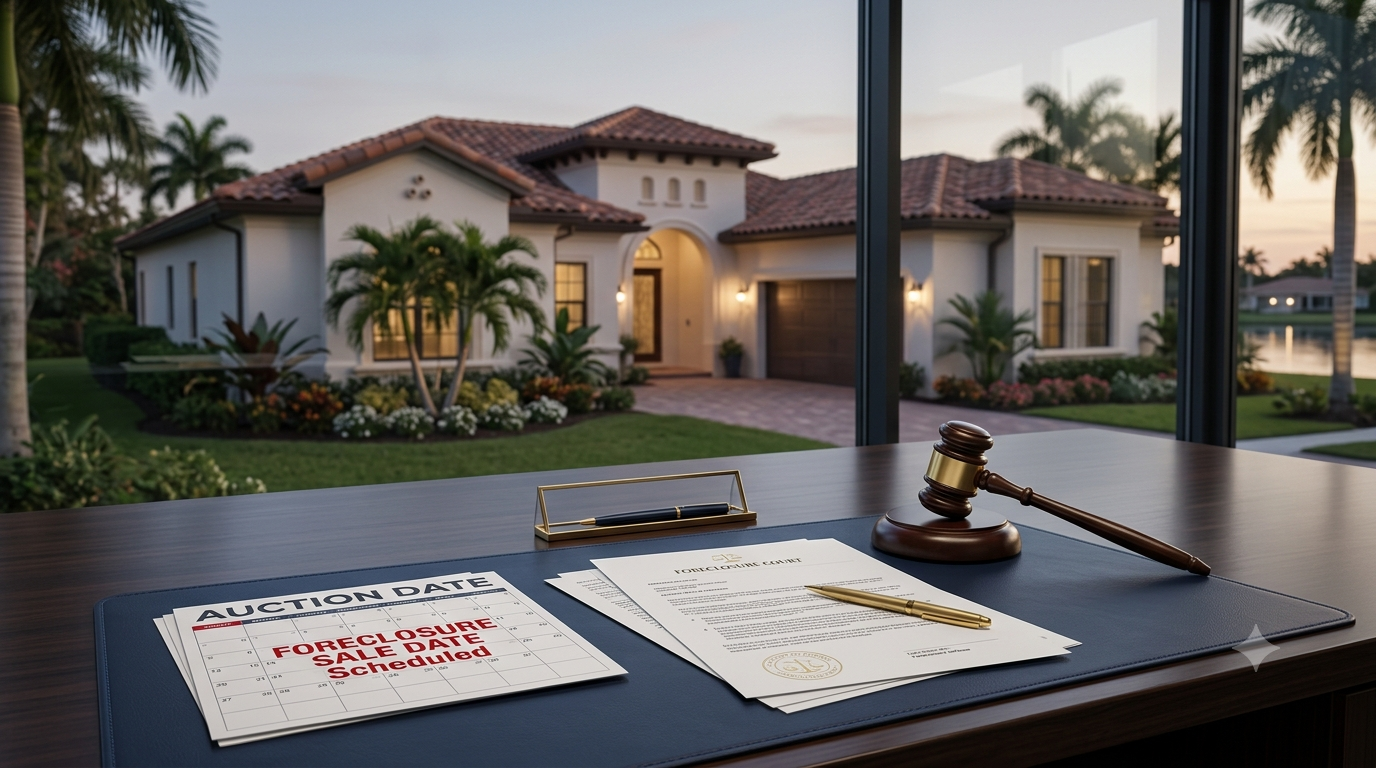
Foreclosure sale date scheduled in Florida? If your home now has an auction date, your foreclosure case has reached an advanced and time-sensitive stage. A final judgment may already have been entered, and the amount of time available to evaluate your legal and financial options may be limited.
Having a foreclosure sale date scheduled in Florida does not automatically mean that every possible option has disappeared. Depending on the facts, homeowners may still need to evaluate Florida’s right of redemption, loss mitigation, negotiations with the mortgage servicer, a voluntary property sale, bankruptcy advice, or whether a legitimate legal basis exists to seek relief from the court.
The most important issue is timing.
Florida foreclosure sales are judicial sales. Florida Statutes section 45.031 governs the judicial-sale process and provides procedures that apply after a foreclosure judgment authorizes the property to be sold.
If you recently learned that a foreclosure sale date is scheduled in Florida, these seven steps can help you understand what should be reviewed before the auction.
What Does It Mean When a Foreclosure Sale Date Is Scheduled in Florida?
A scheduled foreclosure sale generally means the foreclosure lawsuit has progressed beyond its early stages.
Before an auction is scheduled, several events may already have occurred:
- The lender or other plaintiff filed a foreclosure lawsuit.
- The homeowner was served or otherwise notified.
- The homeowner responded, or a default may have been entered.
- Motions or hearings occurred.
- The court entered a final judgment of foreclosure.
- The judgment established amounts the court found due.
- The court authorized a judicial sale.
Florida law provides a statutory process for judicial sales following a judgment or order. Section 45.031 addresses the sale date, publication, bidding, certificate of sale, objections, and certificate of title.
A homeowner should therefore take a foreclosure sale date scheduled in Florida more seriously than an early default letter from a mortgage servicer.
The case is no longer simply about missed payments. A court has likely already taken significant action.
That does not mean every scheduled sale will ultimately take place on the original date. It does mean the homeowner should determine immediately what has happened in the court case and what options may realistically remain.
Can a Foreclosure Sale Date Scheduled in Florida Still Be Stopped?
Potentially.
There is no single strategy that automatically stops every foreclosure auction.
Depending on the circumstances, possible options may include:
- Exercising Florida’s right of redemption
- Paying or otherwise satisfying the judgment
- Obtaining an agreement from the lender or servicer
- Completing an available loss-mitigation option
- Seeking legally supported court relief
- Selling the property before the foreclosure is completed
- Consulting bankruptcy counsel where appropriate
- Addressing a significant procedural or legal problem with the foreclosure
However, having a foreclosure sale date scheduled in Florida does not itself create a legal right to postpone the sale.
An application for mortgage assistance, telephone conversation with the servicer, listing agreement with a real estate agent, or request to the lender should not automatically be treated as confirmation that an auction has been cancelled.
The actual court record and sale status should be checked.
1. Confirm the Foreclosure Sale Date Scheduled in Florida
The first step is confirming the exact auction date, time, and current status of the court case.
Do not rely only on:
- A telephone call
- A collection letter
- A third-party website
- A foreclosure rescue advertisement
- A real estate investor’s communication
- An old court notice
Review the official court docket and the final foreclosure judgment.
The judgment may contain information about the sale and other important terms.
Florida’s judicial-sale statute establishes procedures for sales conducted under court authority. The law also provides that a sale may occur more than 35 days after final judgment when the plaintiff or plaintiff’s attorney consents to that timing.
If a foreclosure sale date is scheduled in Florida, confirm whether any subsequent order has postponed, cancelled, or rescheduled it.
This matters because foreclosure dates can change.
A homeowner should not assume the sale is cancelled unless that cancellation can be verified.
2. Review the Final Foreclosure Judgment
Once the auction date is confirmed, obtain the final judgment.
The judgment is one of the most important documents in the case.
It may identify:
- The principal amount found due
- Interest
- Court costs
- Attorney’s fees
- Advances
- Other amounts awarded
- The legal description of the property
- The foreclosure sale provisions
- Redemption-related language
- Other court directives
If you have a foreclosure sale date scheduled in Florida, the judgment should be reviewed together with the earlier court filings.
An attorney may also want to examine:
- The foreclosure complaint
- Summons
- Proof of service
- Mortgage
- Promissory note
- Assignments
- Payment history
- Default notices
- Answers and affirmative defenses
- Motions
- Hearing notices
- Summary judgment filings
- Prior court orders
The purpose is not merely to look for a technical argument.
The goal is to understand whether the proceedings occurred properly, whether a legitimate unresolved legal issue exists, and what remedies may still be available.
3. Determine Whether Florida’s Right of Redemption Applies
One of the most important issues when a foreclosure sale date is scheduled in Florida is the statutory right of redemption.
Florida Statutes section 45.0315 provides that, before the later of the filing of the certificate of sale or the time specified in the foreclosure judgment, order, or decree, the mortgagor or a holder of a subordinate interest may cure the indebtedness and prevent the foreclosure sale by paying the amount required under the statute.
This is commonly called the right of redemption.
The amount required to redeem may be significantly greater than simply paying several missed monthly payments.
Depending on the judgment and circumstances, the amount could involve:
- Outstanding principal
- Interest
- Court costs
- Attorney’s fees
- Taxes advanced by the lender
- Insurance advances
- Other expenses allowed by the judgment
A homeowner considering redemption should obtain the appropriate payoff information as early as possible.
Waiting until immediately before the auction can create practical problems involving funding, payoff calculations, wire transfers, court procedures, and verification.
If a foreclosure sale date is scheduled in Florida and the homeowner has access to funds, refinancing, family assistance, or sale proceeds, redemption should be evaluated promptly.
4. Check Whether Loss Mitigation Is Still Available
A homeowner may also be working with the mortgage servicer on foreclosure alternatives.
Potential loss-mitigation options can include:
- Loan modification
- Repayment plan
- Forbearance
- Short sale
- Other available alternatives to foreclosure
Federal servicing rules contain specific protections related to complete loss-mitigation applications.
The Consumer Financial Protection Bureau explains that when a servicer receives a complete loss-mitigation application more than 37 days before a scheduled foreclosure sale, federal rules generally require the servicer to evaluate the borrower for available loss-mitigation options and provide a written response within the applicable timeframe.
Timing is therefore critical.
If you have a foreclosure sale date scheduled in Florida, determine:
- When your application was submitted
- Whether the servicer considers it complete
- Whether additional documents were requested
- When those documents were provided
- Whether a written decision was issued
- Whether you were offered an option
- Whether an appeal period applies
- Whether the foreclosure sale has actually been postponed
Do not assume that simply saying “I applied for a modification” means the auction cannot proceed.
The CFPB regulations specifically address applications submitted 37 days or less before a foreclosure sale differently from those submitted earlier.
A Pending Modification Does Not Automatically Cancel the Sale
This is an important distinction.
A homeowner may be talking to the servicer’s loss-mitigation department while the foreclosure law firm continues handling the court case.
If a foreclosure sale date is scheduled in Florida, ask for written confirmation of any postponement or cancellation and verify the court or auction status.
Keep records of:
- Letters
- Emails
- Online portal messages
- Fax confirmations
- Application documents
- Approval or denial notices
- Representative names
- Dates and times of telephone calls
Those records may become important if there is later a disagreement about the modification process.
5. Consider Whether Selling the Property Is Realistic
Some homeowners focus entirely on stopping foreclosure when selling the property may also deserve consideration.
This is particularly important when there is substantial equity.
If a foreclosure sale date is scheduled in Florida, a voluntary sale may potentially allow a homeowner to pay the mortgage, resolve other liens, preserve remaining equity, and control the timing of the move.
But listing the property does not automatically stop the foreclosure.
A successful closing may require:
- A qualified buyer
- Signed purchase agreement
- Clear title
- Mortgage payoff
- Resolution of other liens
- Sufficient closing time
- Coordination with the lender and closing professionals
The closer the auction date becomes, the more difficult completing a conventional sale may be.
What If the Property Is Worth Less Than the Mortgage?
A short sale may be another possibility depending on the lender and circumstances.
A short sale generally involves selling the property for less than the total mortgage debt with lender approval.
The CFPB identifies short sales as a possible loss-mitigation option for borrowers facing foreclosure.
However, short sales can require lender review, financial information, valuation, a purchase contract, and negotiation.
If a foreclosure sale date is scheduled in Florida, there may not be enough time to start a complicated short-sale process from scratch.
This is another reason early action matters.
6. Review Possible Legal Issues Before the Foreclosure Sale
A scheduled auction does not automatically mean there is a legal basis to stop the foreclosure.
However, certain cases may contain issues that deserve immediate legal review.
Examples could include:
- Questions regarding service of process
- A potentially improper default
- Significant problems with the judgment
- A settlement that was not reflected in the case
- Payment or satisfaction issues
- Fraud or misrepresentation
- Significant procedural irregularities
- Other legally recognized grounds for relief
Florida courts have authority in appropriate circumstances to address foreclosure judgments and sales, but relief must be supported by law and the facts of the particular case.
A homeowner cannot simply request additional time because the auction is inconvenient.
What If You Were Never Served?
If you discover a foreclosure sale date scheduled in Florida but do not remember receiving the foreclosure complaint, service should be reviewed immediately.
An attorney may examine:
- The return of service
- Address used for service
- Identity of the person served
- Substitute-service information
- Publication records, if applicable
- Other documents showing how jurisdiction was obtained
A lack of proper service can potentially be significant, but it does not automatically erase the underlying mortgage obligation.
The entire procedural history needs to be evaluated.
What If You Already Participated in the Case?
If you previously filed an answer, attended hearings, or litigated defenses, the analysis may be different.
The attorney may need to determine:
- What issues were already decided
- Whether a final judgment was entered after summary judgment or trial
- Whether any appeal period remains relevant
- Whether new circumstances have arisen
- Whether another legally recognized basis for relief exists
The closer a foreclosure sale date scheduled in Florida gets, the less time there may be to conduct this review.
7. Speak With a Florida Foreclosure Attorney Before the Sale
Legal review becomes especially important when the foreclosure reaches the auction stage.
A foreclosure attorney can review the court record and help determine which options are legally realistic.
That may include evaluating:
- Final judgment
- Sale notice
- Service history
- Mortgage documents
- Loan modification records
- Payment history
- Redemption options
- Property equity
- Pending property sale
- Available defenses
- Procedural issues
- Settlement possibilities
An attorney should not guarantee that the foreclosure sale can be stopped.
The appropriate question is whether there is a legitimate legal, financial, or negotiated path that could change what happens next.
If your foreclosure sale date is scheduled in Florida, waiting until the final hours before the auction can substantially limit what can realistically be reviewed or pursued.
Can Bankruptcy Stop a Scheduled Foreclosure Sale?
Bankruptcy is another issue homeowners sometimes consider.
A bankruptcy filing can trigger the federal automatic stay in many circumstances, which may affect ongoing collection and foreclosure activity.
However, bankruptcy is a separate area of federal law and should not be treated merely as a last-minute foreclosure tactic.
Whether bankruptcy is appropriate can depend on:
- Income
- Assets
- Other debts
- Mortgage arrears
- Home equity
- Previous bankruptcy filings
- Ability to maintain future payments
- Type of bankruptcy filing
Homeowners considering bankruptcy should speak with qualified bankruptcy counsel.
A foreclosure lawyer and bankruptcy attorney may need to coordinate when a foreclosure sale date is scheduled in Florida and both foreclosure and insolvency issues are present.
What Happens at the Florida Foreclosure Sale?
Florida Statutes section 45.031 governs judicial sales and provides procedures involving notice, bidding, the certificate of sale, objections, and ultimately the certificate of title.
In many Florida counties, foreclosure sales are conducted electronically.
The property is offered under authority of the court’s foreclosure judgment.
This is an important legal event.
It is not simply another hearing.
Once the auction occurs and the process advances toward issuance of the certificate of title, the homeowner’s legal position can change significantly.
That is why a foreclosure sale date scheduled in Florida should generally be addressed before the sale rather than on the assumption that it can easily be reversed later.
Can a Florida Foreclosure Sale Be Reversed After the Auction?
Post-sale challenges can exist in limited circumstances, but homeowners should not assume a completed foreclosure sale can simply be undone.
Florida law places importance on the finality of judicial sales.
The rights of third-party purchasers and other statutory protections can also affect what relief remains available after an auction.
For practical purposes, a homeowner who knows the sale date should investigate available options before the property is sold whenever possible.
What Documents Should You Gather Immediately?
If you have a foreclosure sale date scheduled in Florida, gather these documents before a legal consultation.
Court Documents
- Foreclosure complaint
- Summons
- Answer
- Motions
- Hearing notices
- Summary judgment papers
- Final judgment
- Sale notice
- Other court orders
Mortgage Documents
- Mortgage
- Promissory note
- Assignments
- Modification agreements
- Forbearance agreements
- Reinstatement quote
- Payoff information
Payment Records
- Mortgage statements
- Bank records
- Payment receipts
- Escrow statements
- Tax and insurance information
Loss-Mitigation Documents
- Modification application
- Requests for additional documents
- Complete-application confirmation
- Approval or denial letters
- Appeal correspondence
- Emails
- Online portal messages
Property Information
- Estimated value
- Pending purchase agreement
- Other liens
- Title information
- Current occupancy
Having these documents available can make the initial review more useful.
Decide What You Actually Want to Accomplish
A legal strategy should be connected to the homeowner’s real objective.
Ask yourself:
Do I want to keep the home?
If yes, the analysis may focus on redemption, affordable loss mitigation, available defenses, or other ways to resolve the default.
Do I want to sell?
If there is equity, preserving that equity before foreclosure may become the priority.
Can I afford the home going forward?
Stopping or postponing an auction may not provide a long-term solution if the homeowner cannot maintain future housing costs.
Am I disputing the foreclosure itself?
If so, the legal basis for that dispute needs to be identified and supported.
When a foreclosure sale date is scheduled in Florida, having a clear objective can help counsel determine which available paths are actually worth pursuing.
Frequently Asked Questions About a Foreclosure Sale Date Scheduled in Florida
How long before a Florida foreclosure sale can it be stopped?
There is no single deadline that applies to every possible remedy.
Florida’s right of redemption generally continues until the later of the filing of the certificate of sale or the time specified in the foreclosure judgment, order, or decree. Other forms of relief can have different requirements and may need to be pursued much earlier.
Can a foreclosure sale date scheduled in Florida be postponed?
Potentially.
The lender may agree to a postponement, a court may enter appropriate relief, or another legal development may affect the auction.
However, a homeowner should confirm that the sale was actually postponed rather than relying on an informal promise.
Will a loan modification application stop the foreclosure auction?
Not automatically.
Federal mortgage-servicing protections depend partly on when a complete application is submitted. A complete application received more than 37 days before the sale can trigger important evaluation requirements under federal servicing rules.
Can I sell my home if a foreclosure sale is already scheduled?
Potentially.
If sufficient time remains and the transaction can satisfy the necessary liens and mortgage payoff, a voluntary sale may still be possible.
A listing agreement alone does not stop the foreclosure.
Can an attorney guarantee the foreclosure sale will be stopped?
No.
An attorney can review the case, identify legitimate legal issues, evaluate possible remedies, and discuss options with the homeowner. The outcome depends on the facts, timing, court record, applicable law, lender decisions, and other circumstances.
Should I wait until a few days before the foreclosure sale to contact an attorney?
Generally, earlier review provides more time to evaluate documents and possible options.
Once a foreclosure sale date is scheduled in Florida, delay can make practical solutions harder to pursue.
Foreclosure Sale Date Scheduled in Florida? Consider Acting Before the Auction
If you have a foreclosure sale date scheduled in Florida, the case has reached a critical stage.
That does not automatically mean there is no path forward.
Depending on the circumstances, issues such as Florida’s right of redemption, loss mitigation, a voluntary sale, lender negotiations, legal defenses, bankruptcy advice, or other court relief may deserve evaluation.
But time matters.
The Law Offices of Lance Denha, PA assists clients with Florida foreclosure and real estate matters. If your property has a scheduled foreclosure auction, consider having the foreclosure judgment, court docket, mortgage documents, and servicing history reviewed promptly.
Law Offices of Lance Denha, PA
200 S Andrews Ave., Suite 604
Fort Lauderdale, FL 33301
Phone: 844-410-4415
Every foreclosure matter depends on its own facts, procedural history, loan documents, and applicable law. No particular result can be guaranteed.
This article is provided for general informational purposes only and does not constitute legal advice. Reading this article does not create an attorney-client relationship.
